On May 22, 1960, at 19:11 UTC (3:11 p.m. in Chile; 4:11 a.m. JST on May 23), a magnitude Mw 9.5 earthquake struck southern Chile. Known as the Valdivia earthquake or Great Chilean Earthquake, it remains the largest ever instrumentally recorded. The rupture lifted and lowered vast sections of the ground and generated a tsunami that crossed the Pacific, causing casualties in Chile, Hawaii, Japan and the Philippines.
A disaster preceded by powerful foreshocks
The main shock was part of a sequence that began on May 21. The USGS records the main event at 19:11:20 UTC on May 22, 1960. Shaking devastated Valdivia and other southern Chilean communities. Buildings, bridges and roads collapsed, and coastal subsidence permanently changed some shorelines.
Why was the earthquake so powerful?
The rupture occurred at the subduction zone where the Nazca Plate moves beneath the South American Plate. Tension accumulated along the plate boundary before a vast fault segment slipped. A classic USGS geological study describes deformation across a region approximately 1,000 kilometres long. Rapid seabed displacement pushed enormous volumes of water, generating the tsunami.
The tsunami that crossed the Pacific Ocean
Waves struck Chile first and spread across the Pacific basin. NOAA documents local tsunami heights of up to about 25 metres along portions of the Chilean coast. These are site-specific maxima, not a uniform height along the entire coastline. Dangerous waves also reached Hawaii, Japan and the Philippines, proving that great subduction earthquakes can generate life-threatening impacts far from the rupture.
Hawaii: deadly flooding in Hilo
The Hawaii Emergency Management Agency reports 61 deaths and 262 injuries from the 1960 tsunami, with severe destruction in Hilo. Multiple successive waves arrived, a reminder that danger does not end with the first wave.
Japan: a distant tsunami without local shaking
Waves reached Japan on May 24, 1960 (JST), after crossing thousands of kilometres of ocean. Many communities experienced destructive flooding without first feeling the earthquake. Japan’s National Archives reports 142 deaths; a NOAA historical animation reports 139, while an older USGS circular gives 122. The figures reflect different historical sources and methods, so each is attributed rather than presented as a single undisputed total.
How many people died?
Casualty estimates vary substantially by source. NOAA NCEI says the number of people killed in Chile by the earthquake and tsunami is uncertain, citing estimates ranging from 490 to 5,700. Another NOAA historical dataset cites approximately 2,223 deaths from the tsunami across multiple countries. These numbers use different scopes and should not be added together.
What changed after the 1960 catastrophe?
Valdivia advanced scientific understanding of giant earthquakes and demonstrated that distant shores can be struck by tsunamis without any local seismic warning. Better seismometers, sea-level gauges, communication networks and international coordination have strengthened modern tsunami warning systems. People experiencing strong or prolonged shaking near the coast should evacuate to higher ground immediately and follow official guidance.
Frequently asked questions
Was the 1960 Chile earthquake the strongest ever?
It remains the largest measured by modern instruments at moment magnitude 9.5. It was not necessarily the deadliest earthquake in history.
When did the tsunami arrive in Japan?
The earthquake occurred on May 23 at 04:11 JST, while its tsunami arrived along the Japanese coast on May 24.
Why did it kill people far from Chile?
Tsunami energy crossed the Pacific and amplified in vulnerable coastal locations.
Explore EarthSentra’s guides to how tsunamis form and the largest recorded earthquakes.
Official scientific and historical references
- USGS: 1960 significant earthquakes catalogue
- NOAA NCEI: 1960 Chile earthquake and tsunami
- NOAA: historical trans-Pacific tsunami
- USGS: Surviving a Tsunami — Chile, Hawaii and Japan
- National Archives of Japan: the 1960 Chilean tsunami
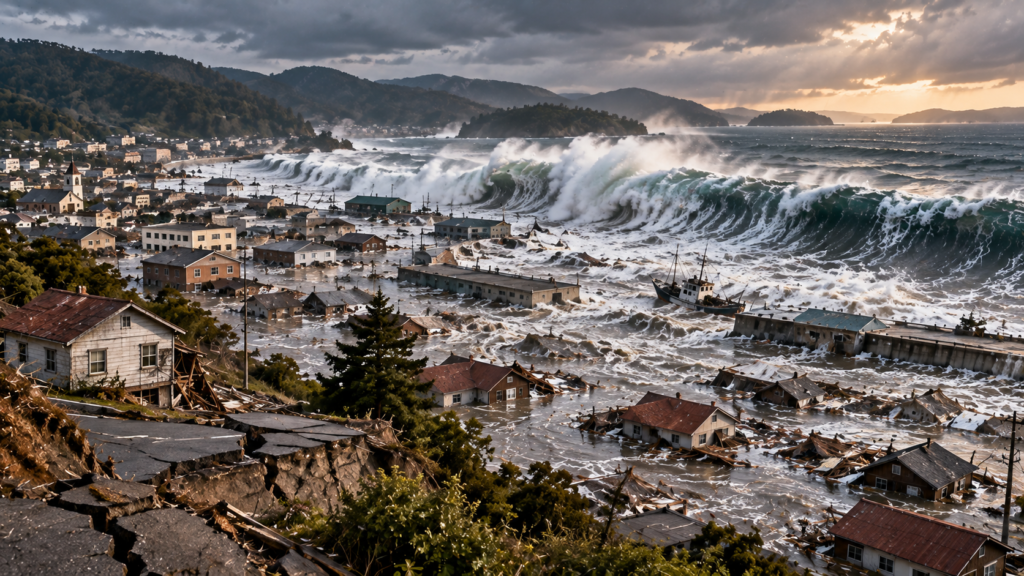
EarthSentra historical research, October 2026. Featured artwork is a conceptual reconstruction, not a photograph from 1960.