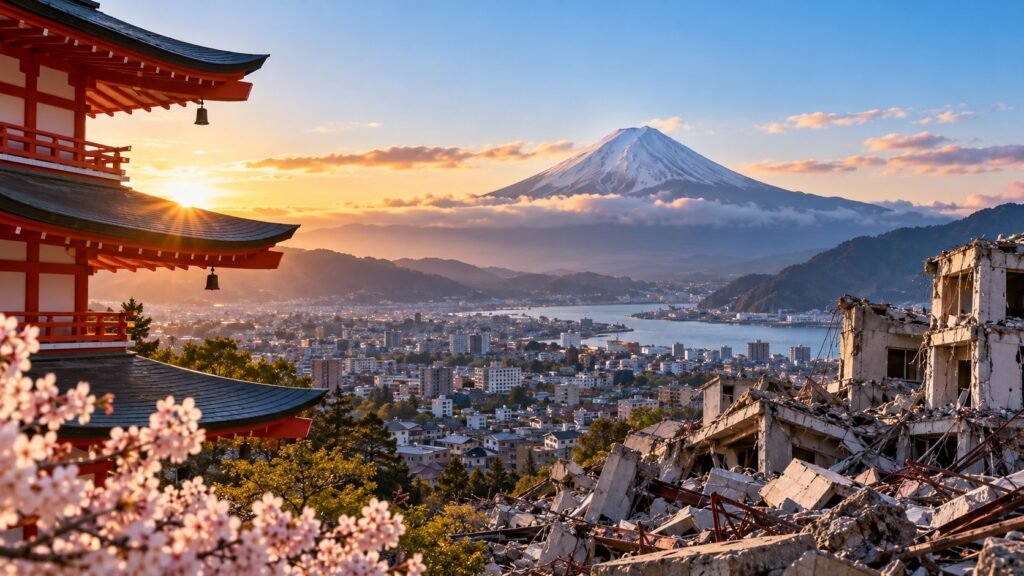
This timeline explores earthquakes in Japan, their impacts, and the lessons left by some of the country’s most devastating seismic events.
Japan is one of the most earthquake-prone countries in the world. Its location within a complex zone of interacting tectonic plates has made major earthquakes a recurring part of its history, profoundly influencing how the country builds its cities, organizes emergency systems, and prepares its population.
Some earthquakes triggered enormous urban fires. Others generated tsunamis that multiplied the destruction. More recent disasters have also tested power grids, roads, hospitals, communications, and evacuation systems.
This timeline looks at some of the most significant earthquakes in modern Japanese history, with particular attention to their magnitude, human losses, material damage, and the lessons they left behind.
Earthquakes in Japan: Nōbi, 1891
On October 28, 1891, an earthquake with an estimated magnitude of M8.0 struck primarily what are now Gifu and Aichi prefectures.
It was one of the most destructive inland earthquakes in modern Japanese history.
The Japan Meteorological Agency records 7,273 deaths.
The earthquake produced extensive surface faulting and destroyed numerous homes. It also became an important event in the scientific study of active faults in Japan.
Magnitude: M8.0
Deaths: 7,273
Tsunami: Not a significant cause of destruction
Main impact: Building collapse and extensive surface faulting.
1896 — Meiji-Sanriku Earthquake and Tsunami
On June 15, 1896, a major earthquake occurred off the Sanriku coast in northeastern Japan.
The Japan Meteorological Agency catalogs the earthquake at M8.2 and records 21,959 deaths.
One of the most important characteristics of this disaster was that the scale of the destruction was not reflected by the shaking alone.
The earthquake generated a devastating tsunami that struck coastal communities throughout the Sanriku region.
The disaster demonstrated a lesson that remains essential today: the strength of the shaking felt by people cannot, by itself, indicate the size of a possible tsunami.
Magnitude: M8.2
Deaths: 21,959
Tsunami: Yes
Main impact: Devastation of coastal communities.
1923 — Great Kantō Earthquake
At 11:58 a.m. on September 1, 1923, an M7.9 earthquake struck the Kantō region.
Tokyo, Yokohama, and numerous surrounding communities suffered severe damage.
But the shaking was only one part of the disaster.
Massive urban fires broke out, while landslides, structural collapses, and a tsunami added to the destruction.
Japanese historical records place the death and missing toll at more than 105,000 people, while hundreds of thousands of homes were destroyed, burned, or swept away.
The disaster profoundly influenced urban planning and disaster management in Japan.
Magnitude: M7.9
Deaths and missing: More than 105,000
Homes destroyed, burned, or swept away: More than 290,000
Tsunami: Yes
Main impact: Ground shaking, urban fires, structural collapse, landslides, and tsunami.
1933 — Shōwa-Sanriku Earthquake
On March 3, 1933, another major earthquake struck the Sanriku region.
The JMA records a magnitude of M8.1 and approximately 3,000 deaths and missing persons.
Once again, the tsunami was responsible for much of the destruction in coastal communities of northeastern Japan.
The repeated tsunami disasters along Sanriku gradually reinforced the importance of evacuation planning, coastal protection, and preserving public awareness of tsunami risk.
Magnitude: M8.1
Deaths and missing: Approximately 3,000
Tsunami: Yes
Main impact: Coastal communities in northeastern Japan.
1944 — Tōnankai Earthquake
On December 7, 1944, an earthquake of approximately M7.9 affected a wide area of Japan.
The event was associated with the Nankai Trough region and also generated a tsunami.
More than one thousand people were killed or reported missing.
Its historical importance is particularly significant because another major earthquake associated with the Nankai system occurred only two years later.
Magnitude: M7.9
Deaths and missing: More than 1,000
Tsunami: Yes.
1946 — Nankai Earthquake
On December 21, 1946, Japan experienced another major earthquake, with a magnitude of approximately M8.0.
The earthquake generated a tsunami and caused widespread damage across southern and western Japan.
The 1944 Tōnankai and 1946 Nankai earthquakes are important historical precedents for understanding why scientists and Japanese authorities closely monitor the possibility of future major earthquakes along the Nankai Trough.
Magnitude: Approximately M8.0
Tsunami: Yes
Historical importance: A major precedent for understanding present-day Nankai Trough earthquake risk.
1995 — Great Hanshin-Awaji Earthquake
At 5:46 a.m. on January 17, 1995, an M7.3 earthquake struck Kobe and southern Hyōgo Prefecture.
Some areas experienced the maximum 7 on the Japanese seismic intensity scale.
The human toll was severe:
6,434 people died, tens of thousands were injured, and more than 100,000 homes were completely destroyed.
Highways, railways, ports, and essential services also suffered extensive damage.
The Kobe disaster became a turning point for modern emergency management and earthquake-resistant construction in Japan.
Magnitude: M7.3
Deaths: 6,434
Injured: More than 40,000
Homes completely destroyed: More than 100,000
Main impact: Building collapse and severe damage to urban infrastructure.
2011 — Great East Japan Earthquake and Tsunami
At 2:46 p.m. on March 11, 2011, Japan experienced the largest earthquake ever instrumentally recorded in the country.
The Tōhoku earthquake reached Mw9.0.
The earthquake generated an enormous tsunami that devastated large areas of Japan’s northeastern Pacific coast and was also associated with the Fukushima Daiichi nuclear accident.
Official records account for around 20,000 people dead or missing, in addition to thousands of injuries and extraordinary destruction of homes and infrastructure.
It is important not to attribute all of these casualties directly to the ground shaking. The tsunami was responsible for a large proportion of the loss of life.
The Japanese government initially estimated direct material damage at approximately ¥16.9 trillion.
Magnitude: Mw9.0
Deaths and missing: Around 20,000
Tsunami: Yes, devastating
Estimated direct material damage: Approximately ¥16.9 trillion
Additional impact: Fukushima Daiichi nuclear accident.
2016 — Kumamoto Earthquakes
In April 2016, Kumamoto experienced an earthquake sequence that demonstrated why the first major shock in a sequence is not necessarily the largest.
On April 14, an M6.5 earthquake reached seismic intensity 7.
About 28 hours later, on April 16, an M7.3 earthquake occurred and again reached seismic intensity 7.
The sequence caused extensive damage to homes, roads, bridges, and other infrastructure, as well as numerous landslides.
Later official statistics also included deaths indirectly related to the consequences of the disaster.
First major event: M6.5
Later major event: M7.3
Maximum seismic intensity: 7
Deaths: More than 270, including disaster-related deaths
Main impact: Buildings, roads, landslides, and prolonged evacuations.
2018 — Hokkaido Eastern Iburi Earthquake
On September 6, 2018, an M6.7 earthquake struck Hokkaido.
A maximum seismic intensity of 7 was recorded in Atsuma, and numerous landslides occurred.
One of the disaster’s most notable consequences was a large-scale blackout that affected virtually all of Hokkaido.
The event demonstrated how earthquake impacts can extend far beyond buildings near the epicenter, affecting electricity, transportation, communications, and other critical infrastructure.
Magnitude: M6.7
Deaths: 43
Tsunami: Not a significant hazard
Main impact: Landslides and widespread disruption of the regional power supply.
2024 — Noto Peninsula Earthquake
On January 1, 2024, while Japan was celebrating the New Year, an M7.6 earthquake struck the Noto Peninsula in Ishikawa Prefecture.
The JMA recorded a maximum seismic intensity of 7 in the hardest-hit areas.
The earthquake was accompanied by a tsunami, fires, landslides, and severe damage to homes, roads, and ports.
One particularly important aspect of the Noto disaster was the subsequent increase in recognized disaster-related deaths associated with evacuation conditions, deteriorating health, and other indirect consequences.
For this reason, the casualty figures continued to be updated long after the immediate emergency.
Magnitude: M7.6
Maximum seismic intensity: 7
Tsunami: Yes
Main impact: Homes, fires, landslides, roads, ports, and isolated communities.
2026 — Kumamoto Earthquake
At 4:27 p.m. on July 28, 2026, Kumamoto was struck by another destructive earthquake, only ten years after the 2016 sequence.
The Japan Meteorological Agency determined a magnitude of M7.1, with a revised depth of 16 kilometers. Its moment magnitude solution was Mw6.8.
The earthquake reached the maximum 7 on the Japanese seismic intensity scale in parts of Kumamoto Prefecture.
It was followed by an intense sequence of earthquakes, including other significant events in the Kumamoto region.
The human and material consequences were substantial. According to the official assessment updated on September 9, 2026, the Kumamoto earthquake resulted in 38 deaths and 371 injuries, including 38 serious injuries and 333 minor injuries. No people were listed as missing in the official assessment.
The scale of material damage also increased significantly as inspections progressed. Authorities recorded 2,249 homes completely destroyed, 5,535 severely damaged, and 36,468 partially damaged, bringing the total to 44,252 homes affected across these three categories.
Because official assessments can continue to evolve after a major earthquake, EarthSentra treats the casualty and damage figures for Kumamoto 2026 as subject to official revision. This is particularly important when documenting recent disasters, as the full human and material impact may not be known during the first days or even weeks following an earthquake.
Magnitude: M7.1 (Mw6.8)
Depth: 16 km
Maximum seismic intensity: 7
Deaths: At least 38 in later government assessments, including possible disaster-related deaths
Material damage: Thousands of homes affected
Additional impact: Strong subsequent seismic activity and evacuations.
Comparison of Major Earthquakes in Japan
| Earthquake | Year | Magnitude | Recorded casualties* | Tsunami |
|---|---|---|---|---|
| Nōbi | 1891 | M8.0 | 7,273 deaths | Not significant |
| Meiji-Sanriku | 1896 | M8.2 | 21,959 deaths | Yes |
| Great Kantō | 1923 | M7.9 | More than 105,000 dead/missing | Yes |
| Shōwa-Sanriku | 1933 | M8.1 | Approx. 3,000 dead/missing | Yes |
| Tōnankai | 1944 | M7.9 | More than 1,000 dead/missing | Yes |
| Nankai | 1946 | Approx. M8.0 | More than 1,000 dead/missing | Yes |
| Hanshin-Awaji | 1995 | M7.3 | 6,434 deaths | Not significant |
| Tōhoku | 2011 | Mw9.0 | Around 20,000 dead/missing | Yes |
| Kumamoto | 2016 | M7.3** | More than 270 deaths | No |
| Hokkaido Eastern Iburi | 2018 | M6.7 | 43 deaths | No |
| Noto Peninsula | 2024 | M7.6 | Toll subsequently revised | Yes |
| Kumamoto | 2026 | M7.1 (Mw6.8) | At least 38* | Not the main hazard |
* Historical casualty figures may vary depending on the source, date of assessment, and whether direct deaths, missing persons, and later disaster-related deaths are included.
** The 2016 Kumamoto sequence began with an M6.5 earthquake on April 14 and was followed by the larger M7.3 earthquake on April 16.
*** The official Kumamoto 2026 toll remained subject to revision when this article was prepared.
How Major Earthquakes Changed Japan
This timeline demonstrates an important point: Japan’s earthquake preparedness culture did not develop all at once.
Each major disaster exposed different vulnerabilities.
Kantō demonstrated the enormous threat posed by urban fires.
Sanriku repeatedly demonstrated the destructive power of tsunamis.
Kobe exposed the vulnerability of buildings and urban infrastructure to shallow earthquakes close to major cities.
Tōhoku showed that even a highly prepared country can face a disaster exceeding previously considered scenarios.
Kumamoto 2016 reinforced the importance of remaining prepared after an initial major shock.
Noto once again highlighted the difficulties of rescue, evacuation, and maintaining essential services in isolated communities.
And Kumamoto 2026 demonstrates that seismic history is not simply a record of the distant past. A region that experienced a major disaster only ten years earlier can suffer another destructive earthquake.
Could Another Major Earthquake Strike Japan?
Yes.
Japan remains highly exposed to earthquakes because of its tectonic setting. However, this does not mean scientists can determine precisely when and where the next major earthquake will occur.
Historical seismic activity helps us understand risk and improve preparedness. It does not provide a date for the next earthquake.
Check Recent Earthquakes in Japan
History explains what happened in the past. Current seismic monitoring shows what is happening now.
On EarthSentra, you can check Earthquakes in Japan Today for recently recorded earthquakes, including their magnitudes, depths, locations, and map visualization.
EarthSentra provides this information for informational purposes. It does not replace official alerts, evacuation orders, or emergency communications issued by authorities.
More Than a Century of Seismic Lessons
Japan’s major earthquakes have caused enormous human and material losses, but they have also transformed science, engineering, and disaster preparedness.
Studying these events is not simply about remembering magnitudes and casualty figures.
It helps explain why modern building standards, warning systems, evacuation routes, emergency drills, and disaster-prevention policies exist.
The inclusion of the 2026 Kumamoto earthquake in this timeline also reminds us of something fundamental: seismic history is still being written.
Understanding the past cannot predict the next earthquake, but it can help societies prepare more effectively when one occurs.
Sources and References
The historical data, magnitudes, casualties, and damage figures in this article were primarily checked against information published by official Japanese institutions. Historical figures may vary depending on methodology, reporting date, and whether direct deaths, missing persons, or later disaster-related deaths are included.
- Japan Meteorological Agency (JMA) — historical earthquake records, magnitudes, seismic intensities, tsunami information, and official data on the 2026 Kumamoto earthquake.
Japan Meteorological Agency - Cabinet Office of Japan — Disaster Management — official disaster reports, casualty assessments, damage information, and government response updates.
Disaster Management, Cabinet Office - Fire and Disaster Management Agency (FDMA) — official damage assessments and emergency-response reports.
Fire and Disaster Management Agency - Reconstruction Agency of Japan — official information and statistics related to the 2011 Great East Japan Earthquake.
Reconstruction Agency
Editorial note: Figures for the 2026 Kumamoto earthquake may continue to be revised by Japanese authorities. EarthSentra will update this article when significant changes are reflected in official reports.