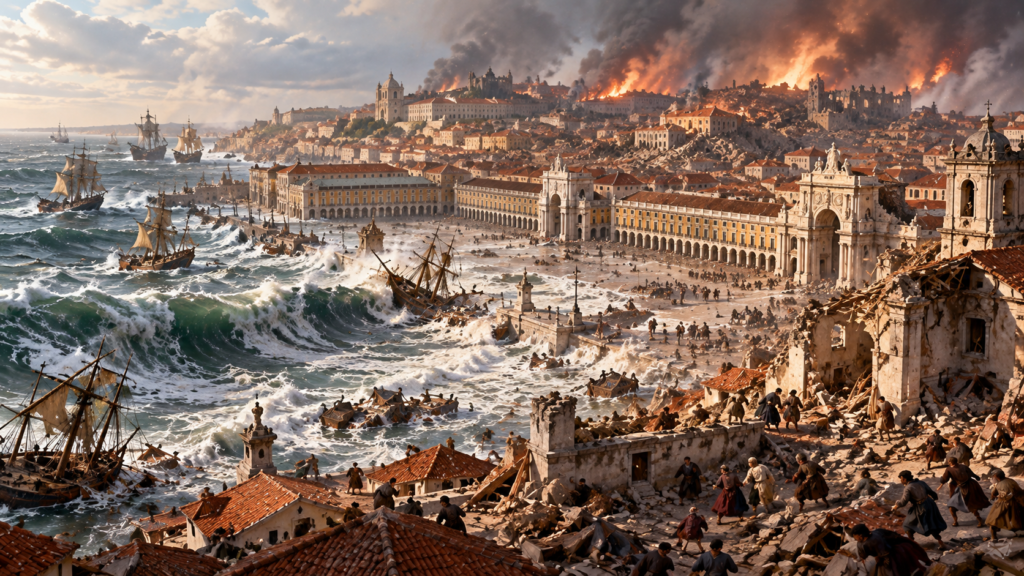
On November 1, 1755, All Saints’ Day, a powerful earthquake devastated Lisbon, Portugal. Within hours, a tsunami surged into the Tagus estuary, while fires spread through the capital. Coastal communities in Spain and Morocco were also affected. The disaster changed European thinking about earthquakes, city planning and disaster preparedness.
The morning Lisbon shook
Religious services had drawn many residents into churches when buildings began to collapse. Because no modern seismographs existed, the earthquake has no precisely measured instrumental magnitude. NOAA’s historical tsunami database uses an estimate of roughly 8.5, while scientific models provide other estimates and continue to debate the earthquake’s exact offshore source.
The tsunami reached the Tagus waterfront
Survivors sought open areas, including the port district. About an hour after the earthquake, the first destructive tsunami waves entered the Tagus estuary; more followed. NOAA’s historical reconstruction describes a maximum local run-up near 12 metres in Lisbon. This is not a single uniform wall of water along the entire coast: tsunami behavior differs dramatically with shorelines and seafloor shape.
Fires prolonged the catastrophe
Large fires broke out after the shaking and spread through the city. A University of Lisbon reconstruction concluded that flames caused much of the destruction across its downtown study area, whereas inundation was concentrated along the riverfront. Lisbon experienced compound hazards: structural collapse, destructive coastal flooding and urban fire.
Impacts beyond Portugal
Powerful tsunami waves affected Cádiz in Spain and stretches of the Moroccan Atlantic coast. Disturbances were also observed in Madeira, the Canary Islands and parts of the North Atlantic, with historical observations reported as far away as the Caribbean. Local damage varied with shoreline geography and exposure.
How many people died?
Reliable totals are impossible to establish with modern precision. NOAA’s Lisbon tsunami account discusses roughly 30,000 earthquake deaths as an estimate and notes that other historical totals are higher. Another NOAA historical table associates approximately 50,000 deaths with the 1755 Lisbon earthquake-tsunami disaster, potentially including earthquake casualties. These are different estimates and should never be added together.
How Lisbon was rebuilt
Under the Marquis of Pombal, Portuguese authorities redesigned central neighborhoods, introducing a more regular street plan and new building approaches that considered earthquake resistance. Contemporary accounts and questionnaires about the disaster also contributed to the development of historical earthquake investigation.
Lasting lessons of the 1755 earthquake
- Hazards can cascade: shaking can trigger coastal flooding and urban fire.
- Tsunamis cross borders: vulnerable communities may be far from the earthquake.
- Reconstruction can reduce risk: better urban layouts and construction practices help future generations.
- Historical measurements are uncertain: magnitudes and casualty totals require careful attribution.
Frequently asked questions
When was the Lisbon earthquake?
On the morning of November 1, 1755, All Saints’ Day.
What was its magnitude?
There was no instrumental measurement. NOAA uses a historical estimate near magnitude 8.5, but the scientific uncertainty remains substantial.
Did the tsunami reach Spain and Morocco?
Yes. Historical studies document destructive impacts on both Atlantic coasts.
Read EarthSentra’s guide to how tsunamis form or explore the largest recorded earthquakes.
Scientific and historical sources
- NOAA: Lisbon 1755 historical tsunami model
- City of Lisbon: history of the earthquake
- University of Lisbon: historical reconstruction
- French Academy of Sciences: Cádiz tsunami analysis
Historical feature reviewed October 2026. Featured image is an artistic reconstruction, not an eyewitness photograph.