

A tsunami is a series of very long waves generated by a large and sudden displacement of water. The most common cause is a strong earthquake beneath or near the ocean floor, although landslides, volcanic activity and, much more rarely, other processes can also displace large volumes of water quickly enough to create a tsunami.
The central idea is simple: a tsunami does not begin as a giant coastal wave; it begins with the sudden displacement of a large body of water. From that moment, the disturbance travels across the ocean and changes dramatically as it enters shallower water.
This guide explains how tsunamis form, what causes them, which earthquakes are capable of generating them, why the waves grow near shore, and which natural warning signs matter most. For current conditions, EarthSentra keeps a separate page for tsunamis today: alerts and current activity.
What is a tsunami
NOAA defines a tsunami as a series of extremely long waves produced by a large and sudden displacement of the ocean. Unlike ordinary wind waves, which mainly affect the ocean surface, a tsunami involves a much larger portion of the water column, from the seafloor toward the surface.
That is why a tsunami may pass almost unnoticed by a vessel in deep water while still carrying enormous energy. The most dramatic effects usually develop when the waves enter shallow coastal water and begin to slow, shorten and grow in height.
Tsunamis are sometimes called “tidal waves,” but that term is misleading because tides do not generate them.
How a tsunami forms step by step
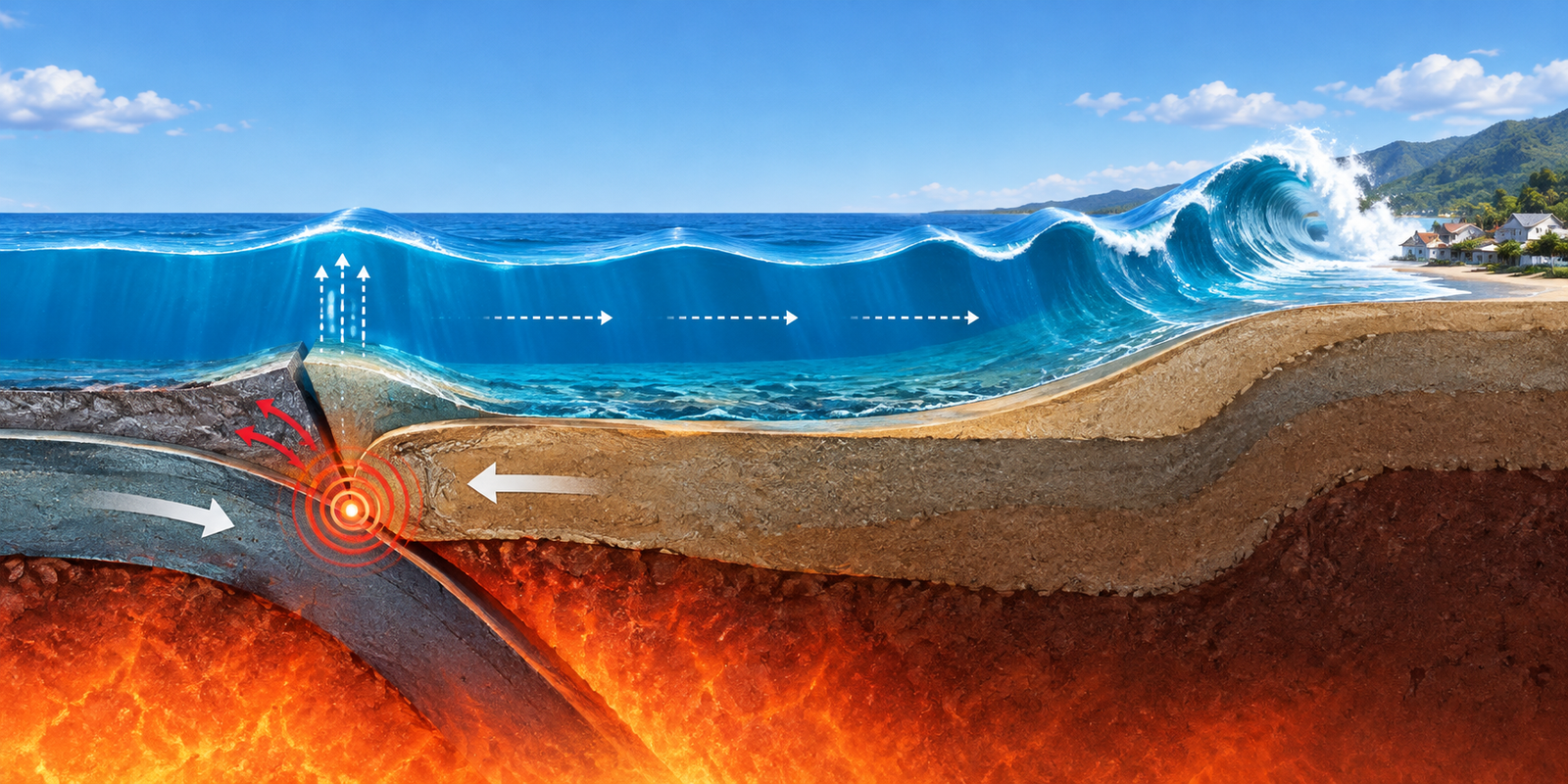
The most common mechanism begins in a subduction zone, where one tectonic plate is forced beneath another. Friction can keep parts of the plate boundary locked for years or centuries while deformation builds.
- The fault ruptures: an earthquake suddenly releases stored energy.
- The seafloor rises or falls: vertical movement displaces the water above it.
- The water tries to regain equilibrium: waves spread outward from the source.
- The waves cross the ocean: in deep water they can travel very fast with relatively little visible height.
- The waves enter shallow water: they slow down, shorten and grow higher.
- The tsunami reaches the coast: flooding, powerful currents, debris and multiple waves may follow.
Why not every earthquake causes a tsunami
A strong earthquake does not automatically produce a dangerous tsunami. The event usually needs to occur beneath or close to the ocean and displace enough of the seafloor to move a large volume of water.
The vertical component of fault motion is especially important. Reverse and thrust earthquakes in subduction zones have generated many of the world’s largest tsunamis because they can uplift or lower broad areas of seafloor.
Earthquakes dominated by horizontal strike-slip motion usually displace less water directly, although they can still trigger underwater landslides that generate local tsunamis.
Main causes of tsunamis
| Cause | Mechanism | Typical reach |
|---|---|---|
| Undersea earthquakes | Rapid displacement of the seafloor and the water above it | Local, regional or ocean-wide |
| Landslides | Rapid movement of rock or sediment into or beneath the water | Often most intense close to the source |
| Volcanic activity | Explosions, collapses or rapid displacement associated with volcanic processes | Varies with mechanism |
| Atmospheric disturbances | Rapid pressure changes and storms that generate meteotsunamis | Usually local or regional |
Earthquakes
Earthquakes are the most common cause. NOAA reports that most known tsunamis have been triggered by earthquakes. The size of the resulting tsunami depends not only on magnitude but also on the amount of vertical seafloor motion, the rupture area, water depth and fault geometry.
Submarine and coastal landslides
A large mass of rock or sediment entering the sea, or moving rapidly underwater, can push water aside and generate a tsunami. Landslide tsunamis may be extremely large near their source, but they often lose energy more rapidly than major earthquake-generated tsunamis that cross entire ocean basins.
Volcanic eruptions and collapses
Volcanic processes can also generate tsunamis through explosions, flank collapse, material entering the sea or large caldera-related displacement. The specific mechanism matters: most volcanic eruptions do not generate tsunamis.
Meteotsunamis and rare causes
Fast-moving atmospheric pressure disturbances can produce sea-level oscillations called meteotsunamis. Large impacts into the ocean are another possible mechanism, but such events are exceptionally rare.
How a tsunami travels across the ocean
In deep water, tsunami waves can travel at speeds comparable to a commercial jet. Their speed depends mainly on water depth: the deeper the ocean, the faster they can move.
High speed does not mean the wave must already be tall. In the open ocean, the surface displacement may be modest while the wavelength is enormous. A tsunami is therefore very different from an isolated breaking surf wave.
Why tsunami waves grow near shore
As water becomes shallower, the tsunami slows. The wave shortens and its energy is concentrated into a shallower water column, which can increase wave height and intensify currents.
Coastline shape, bays, harbors, underwater slopes, reefs and channels can amplify or reduce the impact. Two nearby locations may therefore experience very different wave heights and inundation.
The first wave is not always the largest. A tsunami is a series of waves and dangerous conditions can continue for hours.
What a tsunami can look like at the coast
A tsunami does not always arrive as a towering wall of water. It may appear as a rapidly rising flood, a powerful surge or a sequence of fast-moving currents. In some cases the sea may suddenly recede before a major wave arrives.
That is why people should never remain near the shoreline simply to watch what happens. Natural warning signs demand immediate action.
Natural warning signs of a tsunami
UNESCO-IOC highlights three especially important natural signals:
- Feel: a very strong or long earthquake near the coast.
- See: an unusual and sudden rise or fall in sea level.
- Hear: a strange or loud sound coming from the ocean.
If these signs occur in a tsunami-prone coastal area, move to higher ground or farther inland immediately rather than waiting for an official warning. See EarthSentra’s guide to natural signs of a tsunami and our tsunami evacuation and safety guide.
Tsunamis versus ordinary waves
Ordinary waves are usually generated by wind and mainly affect the ocean surface. A tsunami begins with large-scale displacement and involves a much greater portion of the water column.
The term “tidal wave” should also be avoided because tides are not the cause. A tsunami may arrive during high or low tide, but the tsunami and the astronomical tide are separate phenomena.
Historical examples of different tsunami mechanisms
The 2004 Indian Ocean tsunami was generated by a massive subduction-zone earthquake and affected coastlines across multiple countries. The 2011 Japan tsunami was also associated with a major subduction earthquake and sent measurable waves across the Pacific.
Other events demonstrate that landslides and volcanic processes can generate highly destructive local or regional tsunamis. These examples show why both the source mechanism and the distance to the source matter.
How tsunamis are detected and confirmed
Warning centers combine seismic information with sea-level observations. A potentially tsunamigenic earthquake may trigger an initial assessment, while tide gauges and ocean sensors help confirm whether a tsunami was generated and how it is evolving.
Warnings may be upgraded, downgraded, expanded or canceled as new information arrives. An alert is therefore part of a continuously updated assessment rather than a fixed prediction.
Current activity and safety
This article explains tsunami science. For current alerts and activity, visit Tsunamis Today. During an actual threat, always follow instructions from local authorities.
Frequently asked questions
Does every strong earthquake cause a tsunami?
No. The event must displace enough water, usually through substantial vertical seafloor movement or another mechanism capable of moving a large volume of water.
Is a tsunami only one wave?
No. It is a series of waves. The first may not be the largest and hazardous conditions can continue for hours.
Does the sea always recede before a tsunami?
No. It can happen, but it is not guaranteed. People should never wait for that sign before evacuating.
Can volcanoes generate tsunamis?
Yes. Certain volcanic processes such as major explosions, collapses or rapid movement of material can generate significant tsunamis.
Scientific sources
- NOAA — The science behind tsunamis.
- NOAA — Tsunamis educational resources.
- NOAA — Tsunami generation: earthquakes.
- UNESCO-IOC — Natural tsunami warning signs.
In summary: a tsunami begins when a large body of water is displaced suddenly. Undersea earthquakes are the main cause, but not the only one. Seafloor geometry, ocean depth and coastal shape determine how the hazard changes from its source to the shoreline.
