
A tsunami is not a tidal wave. The expressions are sometimes used interchangeably in everyday English, but they describe different physical processes. A tsunami is a series of long waves produced by sudden displacement of a large volume of water—most commonly during a major undersea earthquake. A tidal wave, in its proper oceanographic sense, is associated with the gravitational forces that produce tides. NOAA explicitly discourages calling a tsunami a “tidal wave.”
Tsunami vs. tidal wave: the main difference
| Feature | Tsunami | Tidal wave |
|---|---|---|
| Cause | Sudden displacement of water, often from an undersea earthquake | Gravitational interactions involving the Moon, Sun and Earth |
| Timing | Unpredictable event, with waves arriving in a series | Connected to regularly recurring tidal cycles |
| Open-ocean behavior | Very long wavelengths, sometimes small apparent wave heights | Part of the periodic motion associated with tides |
| Coastal danger | Powerful currents and potentially catastrophic inundation | Normal tides vary by location; unusually high tides can worsen coastal flooding |
What is a tsunami?
A tsunami is a series of waves generated when water is displaced over a large area or in a sudden event. The Japanese name means “harbor wave.” Large earthquakes along underwater faults are the most common source, but submarine landslides, volcanic eruptions and other processes can also generate tsunami waves. As the waves move from deep to shallow water, they slow down and may become much higher and more destructive.
What is a tidal wave?
According to the NOAA National Ocean Service, a tidal wave is a shallow-water wave resulting from the gravitational interactions among the Sun, Moon and Earth. The term has also been used informally to describe tsunamis, but that usage is misleading because tsunamis are not caused by tides. In scientific communication, simply call a tsunami a tsunami.
Why do people confuse the terms?
Historically, dramatic coastal floods and unexpectedly powerful waves were sometimes described as “tidal waves,” even when they had no connection to a tidal cycle. Popular media helped preserve that usage. Science and emergency-warning agencies prefer the word tsunami because it identifies the correct hazard and avoids confusion about the cause.
Can the tide make a tsunami worse?
Yes. Although tides do not generate a tsunami, the water level when tsunami waves arrive can influence inundation. A tsunami reaching shore near high tide can cause more flooding than an otherwise comparable event arriving at low tide. The tsunami and tide are distinct processes that can interact at the coast.
What causes tsunamis?
- Undersea earthquakes: rapid movement of the seafloor shifts the water above it.
- Landslides: rock and sediment can displace water, sometimes producing damaging local waves.
- Volcanoes: eruptive explosions, flank collapses or pyroclastic material entering water may generate tsunamis.
- Atmospheric disturbances: fast-moving pressure changes can produce meteotsunamis, which are not ordinary gravitational tides.
Real examples of tsunamis
The 2004 Indian Ocean tsunami followed a magnitude 9.1 undersea earthquake off Sumatra. The 2011 Japan tsunami was also generated by a powerful earthquake. In each case, an abrupt shift of the seafloor—not a tidal cycle—generated the dangerous waves.
How to recognize tsunami warning signs
If you are on the coast and feel strong or prolonged shaking, see a sudden abnormal retreat or surge of the sea, or hear an unusual roar from the ocean, move immediately to high ground or inland. Do not wait to see a wave or for an official alert when natural warning signs are clear. Later waves may be larger, and dangerous currents may last for hours.
Frequently asked questions
Is a tsunami the same as a tidal wave?
No. A tsunami is caused by a sudden displacement of water. The term tidal wave properly relates to tides, which are driven by the gravitational influence of the Moon and Sun.
Does the Moon cause a tsunami?
No. The Moon contributes to ordinary tides, but it does not cause earthquake-generated tsunami waves.
Is the first tsunami wave always the biggest?
No. A later surge can be larger, so never return to an evacuated coast until officials say it is safe.
Can tsunamis strike the United States?
Yes. Tsunamis can affect U.S. coastlines, including Alaska, Hawaii, the Pacific coast and other coastal regions. Risk depends on the event and location.
Learn more in our guide to tsunami formation and causes.
Official scientific references
- NOAA: What is a tidal wave?
- NOAA: Tsunamis
- NOAA: The science behind tsunamis
- U.S. Tsunami Warning Centers: tsunami FAQs
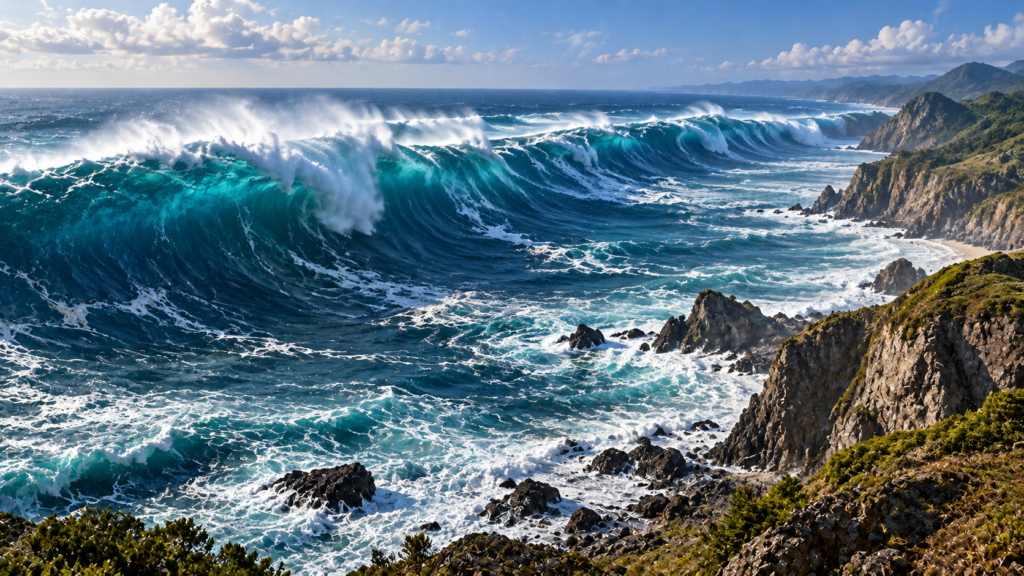
Featured image is conceptual artwork of ocean waves, not a documentary image of a tsunami.

