
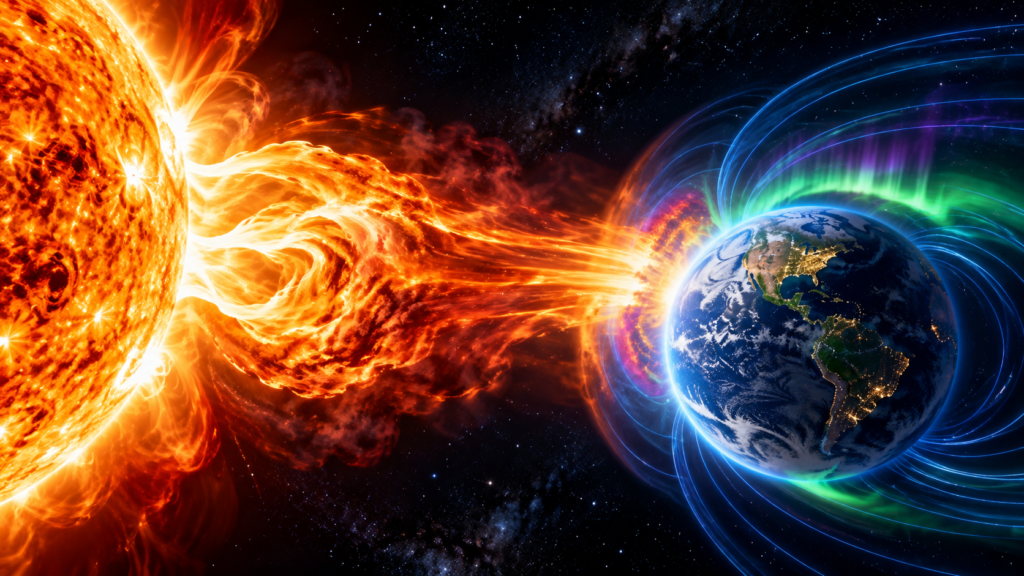
A solar storm is a burst of activity from the Sun involving energy, radiation, magnetic fields and sometimes huge clouds of charged particles. When solar activity is directed toward Earth, it may affect radio communications, GPS, satellites and electric power grids. However, NASA emphasizes that Earth’s atmosphere and magnetic field protect people on the ground from the most harmful direct radiation.
What causes a solar storm?
The Sun’s magnetic field can become tangled and stressed. When magnetic field lines suddenly reconnect, they release energy and can produce solar flares, coronal mass ejections (CMEs) and energetic particles. Not every eruption is aimed at Earth, and solar flares are not interchangeable with geomagnetic storms.
Solar flare vs. CME vs. geomagnetic storm
| Phenomenon | Definition | Possible effect |
|---|---|---|
| Solar flare | A sudden burst of electromagnetic radiation from the Sun | High-frequency radio blackouts on Earth’s sunlit side |
| Coronal mass ejection (CME) | A vast cloud of plasma carrying magnetic fields away from the Sun | May trigger geomagnetic storms if it reaches Earth under favorable magnetic conditions |
| Solar radiation storm | An increased flux of energetic solar particles | Hazards for astronauts and some high-latitude aviation and satellite operations |
| Geomagnetic storm | A disturbance of Earth’s magnetic environment | Auroras, GPS degradation and possible impacts on power networks |
How long does a solar storm take to reach Earth?
Radiation from a solar flare travels at the speed of light and reaches Earth in roughly eight minutes. The plasma of a CME is much slower: a particularly fast CME can arrive in about 15 hours, but many take one or more days. A flare does not automatically mean that a CME will hit Earth.
How do solar storms affect technology?
GPS and satellite navigation
Geomagnetic and ionospheric disturbances can reduce the accuracy of GPS and other GNSS navigation systems. Satellite operators may need to adjust procedures to protect equipment and manage atmospheric drag.
Power grids
Strong geomagnetic storms can induce electric currents in long conductors and affect grid equipment, potentially contributing to outages. Risk depends on storm strength, latitude and grid protections; an alert does not mean a nationwide blackout is inevitable.
Radio and communications
Strong solar flares can interfere with high-frequency radio signals. Solar energetic particles can also affect certain polar communications and satellites. This is particularly relevant for aviation and other operations that rely on radio links.
Auroras
Solar activity can intensify the northern and southern lights. During strong geomagnetic storms, auroras may become visible much farther from the poles than usual.
Can a solar storm harm people?
For people on Earth’s surface, NASA says the planet’s magnetic field and atmosphere shield us from the most dangerous direct effects of solar storms. The situation differs for astronauts outside that protection and may require precautions for high-altitude flights on polar routes during solar radiation events. The principal everyday concern is disruption of technologies rather than radiation injury at ground level.
Understanding NOAA’s G1–G5 geomagnetic storm scale
NOAA’s Space Weather Prediction Center classifies geomagnetic storms from G1 (minor) to G5 (extreme). Stronger levels indicate a greater potential for effects on space operations, navigation and electric systems, though actual outcomes vary. NOAA uses separate R1–R5 ratings for radio blackouts and S1–S5 ratings for solar radiation storms; these scales describe different conditions and must not be confused.
Could a solar storm affect the United States?
Yes. U.S. infrastructure depends on satellites, electrical transmission and positioning systems that can be sensitive to severe space weather. Geomagnetic latitude, storm conditions and the design of each system influence risk; northern regions may experience some effects more strongly, but impacts are not limited to one state or a single type of technology.
What should you do during a solar storm warning?
Use the official NOAA Space Weather Prediction Center for real-time watches, warnings and forecasts. Ordinary readiness for potential power interruptions—charged devices, a flashlight and a way to receive local information—is sensible, but there is no reason for panic or extraordinary personal protective measures based solely on a headline about a solar flare.
Frequently asked questions
Is a solar flare the same as a geomagnetic storm?
No. A solar flare is a radiation burst on the Sun; a geomagnetic storm occurs when Earth’s magnetic field is disturbed, often by a CME or fast solar wind.
Do all solar storms cause blackouts?
No. Most do not cause widespread electrical outages, and effects depend on multiple factors.
Can scientists predict solar storms?
Space-weather agencies track the Sun and forecast hazards, but the intensity and precise timing of impacts can remain uncertain.
Does seeing the northern lights mean a dangerous storm?
Not necessarily. Auroras are visible signs of magnetic activity but do not alone establish an emergency.
Official sources
- NASA Science: Solar Storms and Flares
- NOAA: Space Weather Impacts
- NOAA: Space Weather — Storms From the Sun
- NOAA Space Weather FAQ
Educational guide reviewed October 2026. Featured artwork is a conceptual scientific illustration, not an actual space-weather observation or current warning.

