
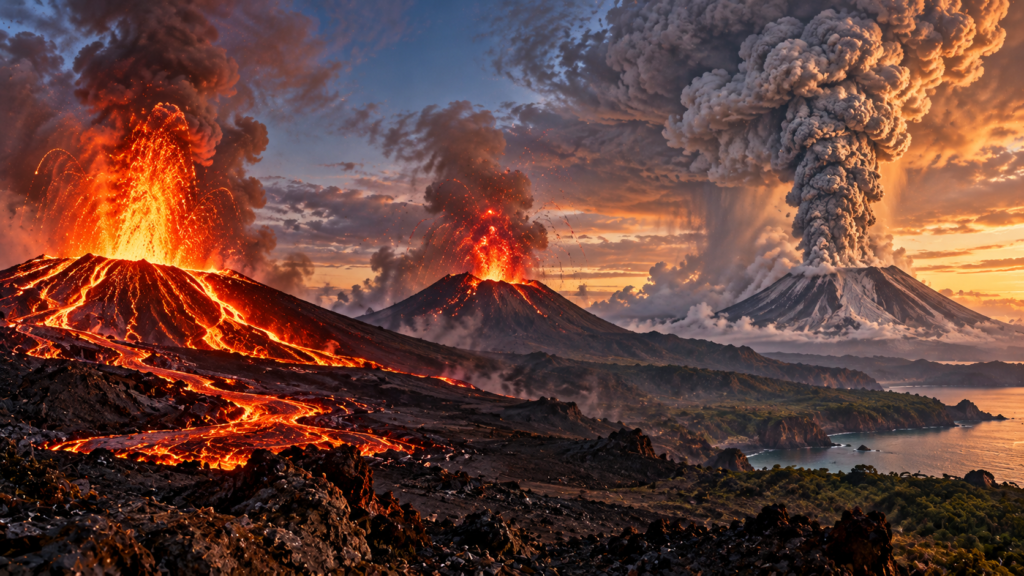
Volcanic eruptions vary enormously. Some release fluid lava, others eject incandescent fragments, and some sustain enormous ash columns. Volcanologists describe Hawaiian, Strombolian, Vulcanian, Plinian, phreatic and phreatomagmatic activity. These terms characterize eruption behavior, not the permanent shape of a volcano.
What determines eruption style?
The most important factors include magma viscosity, dissolved gas content, ascent rate and interaction with external water. Gas that escapes readily can favor lava flows, while trapped gas may fragment magma violently. A single volcano can exhibit multiple eruptive styles during one period of activity.
Comparison of volcanic eruption types
| Style | Typical behavior | Important hazards |
|---|---|---|
| Hawaiian | Fluid lava flows and fountains | Lava, volcanic gases, heat |
| Strombolian | Intermittent bursts of glowing lava fragments | Volcanic bombs and nearby ash |
| Vulcanian | Short, forceful ash-rich explosions | Blocks, ash and blast waves |
| Plinian | Sustained tall ash and gas columns | Widespread ashfall and pyroclastic flows |
| Phreatic | Steam-driven blasts without new magma eruption | Rock fragments and superheated steam |
| Phreatomagmatic | Direct explosive interaction of magma and water | Fine ash, base surges, explosions |
1. Hawaiian eruptions
These typically involve relatively fluid basaltic lava, lava fountains and flows from vents or fissures. Kīlauea and Mauna Loa are classic examples. Even apparently gentle activity may destroy infrastructure and expose communities to hazardous gases.
2. Strombolian eruptions
Bursts occur intermittently as pockets of gas rise and rupture at the magma surface, launching glowing bombs and scoria around the vent. The name comes from Stromboli in Italy. Timing and explosion strength can vary substantially.
3. Vulcanian eruptions
Relatively brief, energetic explosions produce ash clouds, gas and blocks. The name refers to Vulcano in Italy. Flying projectiles and sudden explosions are particularly dangerous near the crater.
4. Plinian and sub-Plinian eruptions
Plinian activity sustains large eruption columns that carry ash and gas high into the atmosphere. Column collapse can generate deadly pyroclastic currents. Classic examples include Vesuvius in AD 79 and Mount Pinatubo in 1991. Sub-Plinian eruptions are generally smaller but can also produce severe hazards.
5. Phreatic eruptions
These are steam-driven explosions when water is heated by hot rock or magma. They expel existing rock fragments without necessarily bringing fresh magma to the surface. They can happen suddenly and may be hazardous even if no lava appears.
6. Phreatomagmatic and Surtseyan eruptions
Direct contact between water and magma promotes rapid fragmentation and violent explosions. Surtseyan eruptions commonly occur in shallow water; the name comes from Surtsey, Iceland, which emerged during an eruption beginning in 1963. Phreatoplinian eruptions describe more sustained magma–water interactions on a larger scale.
Effusive versus explosive eruptions
Effusive eruptions principally release lava; explosive eruptions violently fragment rock and magma. These are ends of a continuum, not rigid boxes. Hawaiian and Plinian describe more specific styles along that spectrum.
Does the Volcanic Explosivity Index identify eruption style?
No. The Volcanic Explosivity Index (VEI) summarizes the size of explosive events using factors such as erupted material volume and column height. It is not a complete hazard rating and does not determine future eruption behavior.
Shared eruption hazards
Regardless of style, hazards can include ashfall, volcanic bombs, lava flows, pyroclastic currents, dangerous gases and lahars. Follow exclusion zones and advice from local volcano monitoring agencies. See EarthSentra’s separate guide to volcano types, which explains volcanic landforms rather than eruption styles.
Frequently asked questions
Which eruptions are most explosive?
Plinian and ultra-Plinian events are among the most explosively powerful magmatic styles, but danger also depends on exposure and location.
Can a volcano change eruption styles?
Yes, even during a single eruption.
Do phreatic eruptions emit new lava?
No. A phreatic blast is steam-driven and ejects preexisting rock without requiring fresh magma at the surface.
Scientific references
- USGS: Types of Volcanic Eruptions
- National Park Service: Eruption Classifications
- USGS: Eruption styles and magma characteristics
- USGS: Phreatomagmatic eruption
EarthSentra scientific guide. Featured image is conceptual artwork combining different eruption styles, not a documentary photograph.

