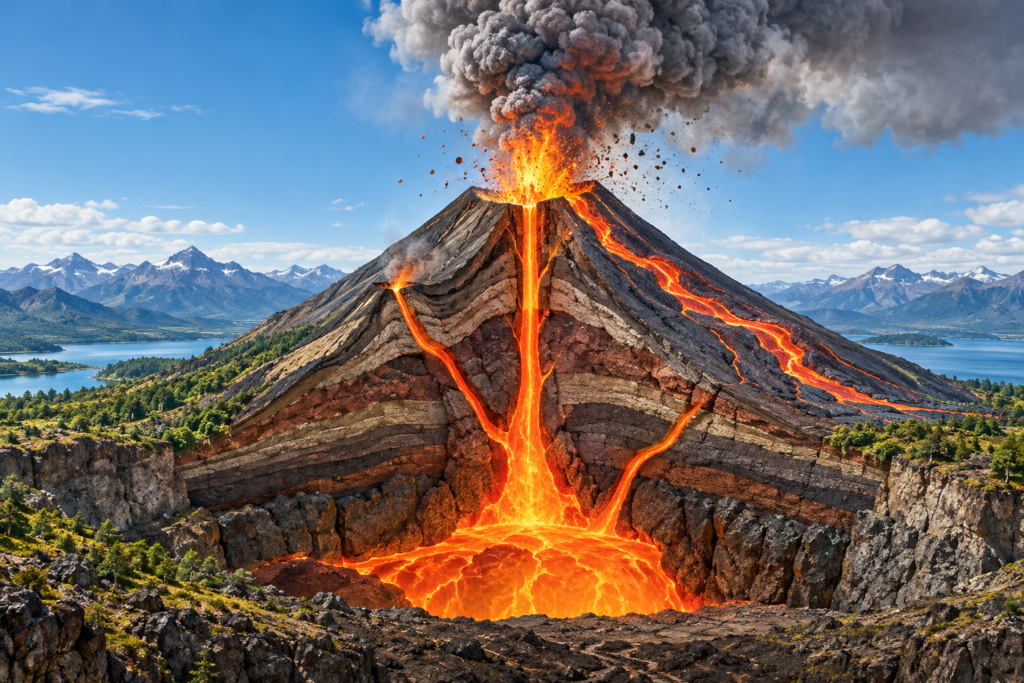

Types of volcanoes differ in far more than shape. Magma viscosity, gas content, eruption style, the materials deposited around a vent, and the long-term history of a volcanic system help explain why some volcanoes are broad and gently sloping while others become steep cones, rugged lava domes, or small hills built from volcanic fragments.
For an introductory classification, the U.S. Geological Survey (USGS) describes four principal forms: shield volcanoes, composite volcanoes or stratovolcanoes, cinder cones, and lava domes. Nature is more complicated, however. The Smithsonian Global Volcanism Program also recognizes calderas, maars, volcanic fields, fissure vents, submarine volcanoes, and other volcanic features. There is therefore no single closed list that fits every scientific purpose.
This guide compares the main volcano types, explains how they form, what materials characterize them, what hazards they may produce, and which examples make them easier to recognize. For live conditions, EarthSentra maintains a separate page for current volcano activity and official alerts.
What a volcano is and why volcanoes develop different shapes
A volcano is an opening, or system of openings, through which magma, gases, and fragmented rock can reach the surface. Over time, erupted material builds landforms that can look dramatically different from one another.
- Magma viscosity: very fluid magma can travel far before cooling, while more viscous magma tends to accumulate closer to the vent.
- Gas content: dissolved gases can promote stronger fragmentation as pressure falls.
- Composition: magma chemistry affects viscosity, temperature, and eruptive behavior.
- Frequency and duration of eruptions: thousands of lava flows can build enormous volcanoes, whereas some cones form during comparatively brief eruptive episodes.
- Water, ice, and topography: interaction with the surrounding environment can change both eruption style and the resulting landform.
Shape is useful for recognizing broad patterns, but it cannot tell us exactly how the next eruption will behave. The same volcano may produce very different activity over its lifetime.

Main types of volcanoes and their characteristics
Shield volcanoes
Shield volcanoes are broad, low-profile structures with relatively gentle slopes. They are built mainly by many flows of very fluid lava that can spread long distances before cooling. Layer after layer gradually produces a wide landform resembling a shield resting on the ground.
The large Hawaiian volcanoes are classic examples. Mauna Loa and Kīlauea show how repeated basaltic lava flows can create enormous volcanic edifices. Although shield volcanoes are commonly associated with effusive activity, that does not mean they are incapable of explosions or other hazards.
Hazards can include lava flows, volcanic gases, ballistic fragments, flank instability, and in some circumstances explosive activity.
Stratovolcanoes or composite volcanoes
Stratovolcanoes commonly form large, steep-sided cones. They are built from repeated layers of lava, ash, and other volcanic material. The alternative term composite volcano reflects that layered construction.
Many of the world’s most recognizable volcanoes belong to this group, including Mount Fuji in Japan and Mount St. Helens in the United States, as well as numerous volcanoes across the Andes and the Pacific Ring of Fire.
Their magmatic systems can produce both effusive and explosive eruptions. Depending on the volcano and the specific event, hazards may include pyroclastic flows, ashfall, lahars, lava flows, and ballistic projectiles. Being a stratovolcano does not by itself predict the size of a future eruption.
Cinder cones
Cinder cones are relatively small volcanic structures built from fragments of lava thrown from a vent and deposited around it. The fragments can accumulate quickly, producing a cone with a visible summit crater.
One of the best-known examples is Parícutin in Mexico, which began forming in 1943 and was observed as it grew on agricultural land. The USGS uses Parícutin as a classic example of cinder-cone development.
Many cinder cones form during comparatively short eruptive episodes and can be accompanied by lava flows. They may also develop as secondary features on the flanks of larger volcanoes or within broad volcanic fields.
Lava domes
Lava domes form when very viscous magma reaches the surface but cannot flow easily away from the vent. Instead of spreading as a long lava flow, the magma piles up into a steep mass that may expand from within.
The USGS makes an important distinction: a dome may be more accurately treated as an eruptive feature rather than a separate volcano type in every classification. Domes frequently grow inside craters or on the flanks of composite volcanoes.
Dome growth can be dangerous because the cooler outer rock may become unstable. Partial collapse can generate hot avalanches of blocks and ash and, in some cases, pyroclastic density currents.
Comparison of the main volcano types
| Type | Typical shape | Dominant material | Common behavior | Example |
|---|---|---|---|---|
| Shield volcano | Very broad, gentle slopes | Fluid lava flows | Often effusive | Mauna Loa |
| Stratovolcano | Tall, steep cone | Layered lava and fragmented deposits | Effusive and/or explosive | Mount Fuji |
| Cinder cone | Small cone with crater | Cinders and other fragments | Moderate explosions with possible lava flows | Parícutin |
| Lava dome | Steep, rounded mass | Very viscous lava | Slow extrusion; possible collapse | Mount St. Helens domes |
Calderas, fissures, maars, and volcanic fields
The four-type framework is useful for learning the best-known volcanic forms, but it does not describe the full diversity of volcanism. The Smithsonian Global Volcanism Program uses additional morphological categories because many systems do not fit a single classic cone.
Calderas
A caldera is a large volcanic depression that can form when an eruption removes enough magma for part of the overlying ground to collapse. It is not simply an oversized crater; its development may involve complex structural processes across a large volcanic system.
Fissure vents
In some eruptions, lava emerges along elongated fractures instead of from one central vent. Fissure eruptions can feed extensive lava flows and build volcanic landscapes without creating a single dominant cone.
Maars
Maars are explosion craters commonly associated with interaction between rising magma and groundwater. They tend to form broad, low depressions surrounded by fragmented deposits.
Volcanic fields
A volcanic field contains many eruptive centers spread across a region. Rather than one huge volcano erupting repeatedly from the same location, separate cones, domes, or fissures may become active at different points within the field.
Submarine volcanoes
A major share of Earth’s volcanism occurs beneath the ocean. Submarine eruptions can build seamounts, islands, and new oceanic crust, while water pressure and eruption depth strongly influence how the erupting material behaves.
Volcano shape and eruption style are not the same thing
It is tempting to reduce the relationship to a simple rule: shield volcano equals quiet eruption, stratovolcano equals explosive eruption. That can be useful as a first approximation, but it is too rigid.
Explosivity depends on magma properties, gases, the conduit system, interaction with water, and other conditions that may change through time. A volcano dominated by lava flows can still produce explosive episodes, while a stratovolcano can also produce relatively quiet lava effusion during some phases.
That is why observatories evaluate current signals such as seismicity, deformation, gas emissions, temperature, and visual observations rather than relying only on the volcano’s shape. EarthSentra explains this distinction further in its guide to volcano alert levels.
Which type of volcano is the most dangerous
There is no volcano type that is always “the most dangerous.” Risk comes from the combination of hazardous processes and human exposure.
A stratovolcano may generate devastating pyroclastic flows and lahars, but lava from a shield volcano can also destroy roads, homes, and infrastructure. An unstable lava dome can collapse suddenly, while a comparatively small cinder cone can still create a serious emergency if it develops near a community.
Distance, topography, wind, snow or water, population density, and evacuation capacity also matter. Hazard agencies therefore prepare maps for individual volcanoes rather than applying one rule based only on shape.
Examples of well-known volcanoes
- Mauna Loa, Hawaiʻi: one of the world’s best-known shield volcanoes.
- Mount Fuji, Japan: a highly symmetrical stratovolcano and one of the world’s most recognizable volcanic landforms.
- Parícutin, Mexico: a cinder cone whose growth was documented from its birth in 1943.
- Mount St. Helens, United States: a stratovolcano that has also grown lava domes within its crater.
- Yellowstone, United States: a volcanic system dominated by a large caldera, illustrating why volcanism cannot be reduced to cone-shaped mountains.
For examples of how eruptions have affected societies, see volcanic eruptions that changed history.
How to identify a volcano type without oversimplifying it
An initial identification may use the volcano’s geometry: slope, relative height, footprint, crater shape, domes, and deposit patterns. A full scientific classification, however, draws on geologic mapping, rock chemistry, eruption ages, and analysis of volcanic products.
One system can also contain several landforms. A stratovolcano may host lava domes; a caldera may contain cinder cones; a shield volcano may include fissures, secondary cones, and a summit caldera. Volcanic systems evolve over thousands to millions of years and often combine multiple features.
Volcano types and current activity
Morphological classification explains how a volcano is built, but it does not tell us whether that volcano is currently restless or erupting. Determining present activity requires monitoring data and official assessments.
EarthSentra separates those two needs: this guide explains volcano types, while Volcanoes Today provides current activity and official alerts. If an eruption affects your area, always follow local authorities and review our volcanic-eruption safety guide.
Frequently asked questions about volcano types
How many types of volcanoes are there
There is no single number used by every classification. The USGS presents four principal forms for educational purposes, while other institutions also distinguish calderas, maars, fissure vents, volcanic fields, submarine volcanoes, and additional features.
Can one volcano belong to more than one type
Yes. A volcanic system can contain several morphologies at once or develop them during different stages of its evolution. A stratovolcano, for example, may contain a lava dome and secondary cones.
Are shield volcanoes always quiet
No. Their construction is commonly dominated by fluid lava and effusive activity, but they can also produce explosions and other hazards. “Effusive” does not mean “risk-free.”
Are all stratovolcanoes highly explosive
No. Stratovolcanoes can alternate between explosive and effusive phases. The hazards of a particular eruption depend on the magma and volcanic system at that time.
Scientific sources
- U.S. Geological Survey — Principal Types of Volcanoes.
- U.S. Geological Survey — About Volcanoes.
- Smithsonian Institution, Global Volcanism Program — Volcano Types and Features.
In summary: volcano types are useful tools for understanding how volcanic systems are built and how they may behave, but no volcano can be reduced completely to one label. Shape, composition, eruptive history, and present monitoring data need to be interpreted together.