
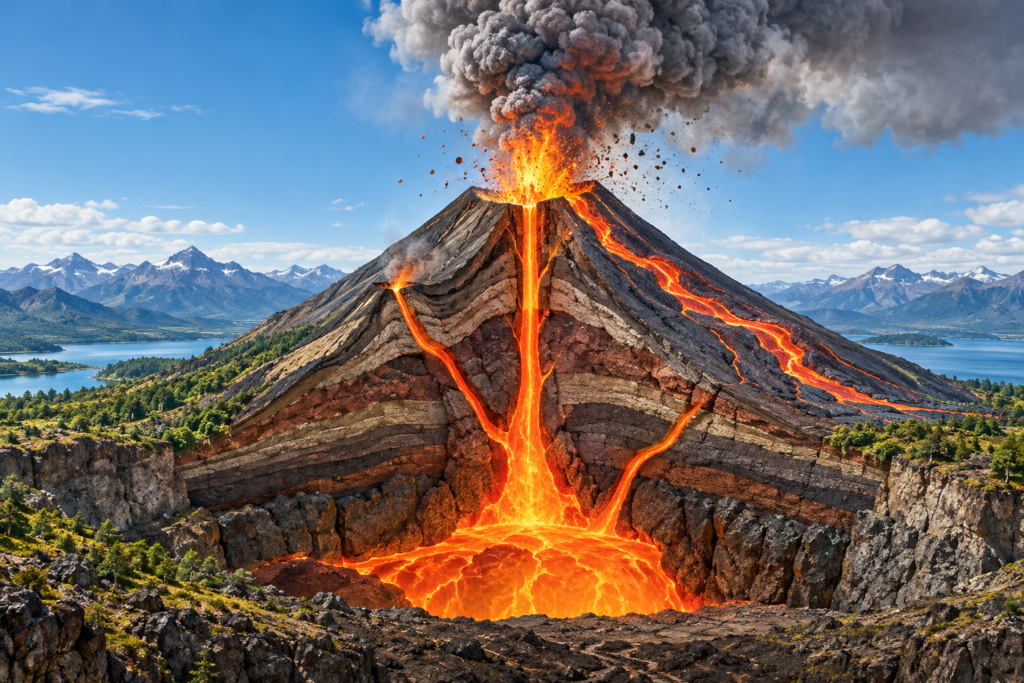
A volcano is a geological system through which magma, gases, and rock fragments can move from inside the Earth toward the surface. Although every volcano is different, many share a number of basic structures that help explain how eruptions happen.
What are the main parts of a volcano?
The main parts of a volcano include the magma chamber, the main vent or conduit, secondary vents, the crater, the volcanic cone, and in some volcanoes, a caldera. Each plays a different role in the volcanic system.
1. Magma chamber
A magma chamber is a subsurface zone where magma may accumulate. It is not always a single empty cavity; in many volcanic systems it is better understood as a network of reservoirs and partially molten zones.
As pressure and magma movement increase, molten material may migrate upward and feed an eruption.
2. Main vent or conduit
The main vent is the pathway through which magma rises toward the surface. During an eruption it may carry lava, gases, ash, and other volcanic material.
Its shape can change over time, and some volcanoes develop several conduits rather than one simple central pipe.
3. Secondary vents
Secondary vents branch away from the main volcanic plumbing system. They can allow magma to reach other parts of the volcano and may create side vents, small cones, or eruptive fissures.
This is why eruptions do not always occur only from the summit crater.
4. Crater
A crater is a depression that commonly surrounds an eruptive opening. It is one of the most recognizable features of many volcanoes.
Lava, gas, ash, and rock fragments can be expelled through the crater during volcanic activity.
5. Volcanic cone
The volcanic cone is the landform built around an eruptive center by repeated accumulation of lava, ash, and other volcanic deposits.
Not every volcano forms a tall, symmetrical cone. Shape depends on magma composition, eruption style, and the types of material produced.
6. Caldera
A caldera is a large volcanic depression that can form when part of a volcanic system collapses after a major movement or withdrawal of magma.
Calderas are generally much larger than ordinary craters and may be several kilometers wide.
7. Lava flows
Once magma reaches the surface, it is called lava. Lava may move downslope in flows whose speed and reach depend on composition, temperature, slope, and erupted volume.
8. Ash and gas plume
Explosive eruptions can send ash, gases, and rock fragments upward in an eruption column. Ash can travel far from the volcano depending on wind conditions and plume height.
A simple volcano diagram in words
In a simplified model, magma is stored or transported at depth, rises through conduits, and can erupt from the main crater, lateral vents, or fissures. Repeated eruptions gradually reshape the volcanic edifice.
Do all volcanoes have the same parts?
No. This is a general model. Some volcanoes have large calderas, others have many side vents, while some volcanic systems are dominated by fissures and do not have a single central cone.
Submarine volcanoes and heavily eroded volcanic systems may also look very different at the surface.
Why is it useful to know the parts of a volcano?
Understanding volcano anatomy makes it easier to read hazard maps, monitoring reports, and news about volcanic activity. It also helps explain why new vents or fissures can sometimes open away from the summit.
On EarthSentra you can explore our volcano overview, check current volcanic activity, and read our guide to types of volcanoes.
Important: this article is educational. During a volcanic emergency, always follow instructions from official local authorities.

