
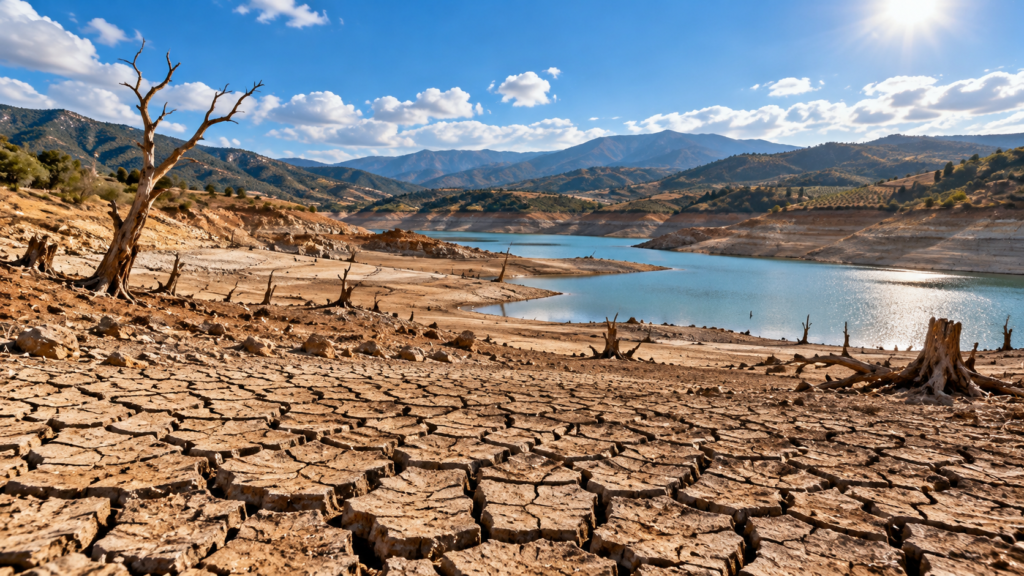
A drought is an extended period of unusually low water availability compared with what is normal for a particular region, causing problems for farming, ecosystems, drinking water or economic activities. It is more than a few hot, dry days: its severity depends on the rainfall deficit, temperature, evaporation, water demand and local vulnerability.
What causes a drought?
Drought often begins with sustained precipitation below the local average. Persistent atmospheric patterns can limit rain or snow, while unusually high temperatures and evaporative demand can dry soil and vegetation faster. Water use and aquifer depletion may worsen shortages without themselves being the cause of meteorological drought. Conditions and thresholds differ between places, which is why experts say that drought is inherently local.
What are the different types of drought?
| Type | Definition | Common impact |
|---|---|---|
| Meteorological | Rain or snowfall falls below what is normally expected. | Persistent dry weather. |
| Agricultural | Soil moisture cannot adequately support crops or grazing. | Reduced harvests and stressed pasture. |
| Hydrological | Water levels and flows in rivers, lakes, reservoirs or aquifers decline. | Water-supply and hydropower problems. |
| Socioeconomic | Water shortages affect supply and demand for goods or services. | Rising costs and reduced production. |
| Ecological | Water deficits disrupt natural ecosystems and services. | Damaged habitats and stressed wetlands. |
These types are related but not interchangeable. For example, plants may experience moisture stress before a reservoir shows substantial decline.
How does drought develop over time?
At first, precipitation deficits may appear in weather observations and soil measurements. As dry conditions persist, groundwater recharge and streamflow may decline, sometimes with a long delay. Recovery can also be uneven: a wet week may improve topsoil moisture without restoring depleted groundwater or large reservoirs.
What are the effects of drought?
Farming and food production
Crop yields, grazing conditions and irrigation supplies can suffer. Impacts depend on crop type, growth stage, irrigation access and the timing of dry conditions.
Water supplies and electricity
Lower rivers and reservoirs can constrain municipal water supplies and hydroelectric generation. Water managers must balance domestic, industrial, agricultural and ecological needs.
Health, ecosystems and wildfire risk
Drought can harm wildlife habitats and water quality, cause economic and psychological stress, and contribute to vegetation dryness that favors wildfires when additional ignition and weather conditions are present.
Drought in the United States
The United States experiences different drought patterns across the West, Great Plains, Midwest, Southeast and other regions. Impacts vary: snowpack losses can reduce water available later in the year, while dry soil can quickly affect crops. The U.S. Drought Monitor provides regularly updated assessments; this article does not claim any particular state is currently in drought.
How is drought measured?
Scientists combine rainfall records, temperature, soil moisture, snowpack, reservoir levels and streamflow. They may use indices such as the Standardized Precipitation Index (SPI) and related indicators. NOAA and the U.S. Drought Monitor draw on multiple datasets because no single number measures all aspects of drought.
How do El Niño and climate change relate to drought?
Ocean-atmosphere patterns can shift precipitation, creating drought risk in some regions and wetter conditions in others. EarthSentra’s guide to El Niño and its global impacts explains why its consequences are not uniform. A warming climate can increase evaporative demand and intensify some drought conditions, but the influence varies by region and individual event.
Can drought impacts be reduced?
Effective measures may include reducing water losses, maintaining healthy watersheds, improving irrigation efficiency, protecting groundwater and planning for prolonged shortages. Communities can consult water utilities and official emergency agencies for locally appropriate conservation measures. Drought planning is different from the response needed for sudden flooding, though both require water-management preparation.
Frequently asked questions
How long does it take for a drought to begin?
There is no universal number of rain-free days: drought definitions depend on local climate, measurements and impacts.
Is drought the same as desertification?
No. Drought is a period of water deficiency, while desertification is a longer-term process of land degradation in drylands.
Can a drought end after heavy rainfall?
Not necessarily. A major storm may improve surface moisture while streams and groundwater remain depleted.
Are droughts always caused by climate change?
No. Droughts also arise from natural climate variability; human-caused warming can change their severity or likelihood in some locations.
For broader context, explore the main types of natural disasters.
Official scientific sources
- NOAA / Drought.gov: Drought Basics
- NOAA: Drought in America
- National Weather Service: Drought Types
- UNDRR: Drought
Educational article reviewed October 2026. Featured image is conceptual artwork, not documentation of a current drought.

