
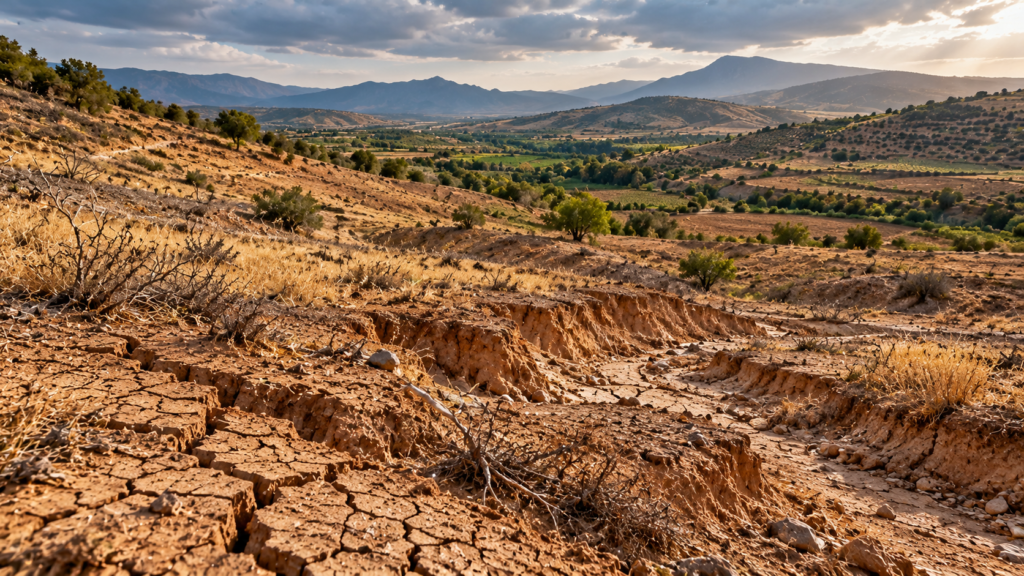
Desertification is land degradation in arid, semi-arid and dry sub-humid regions, caused by climate variability and human activities. That is the official definition used by the United Nations Convention to Combat Desertification (UNCCD). It does not simply mean that existing deserts are spreading: it means that the productivity and ecological functions of dryland soils, vegetation and landscapes are being impaired.
What causes desertification?
Several pressures can interact. Unsustainable grazing can remove protective vegetation; deforestation and inappropriate farming practices expose soils to erosion. Poorly managed irrigation may cause salinization, while prolonged drought and high evaporative demand can hamper recovery. Climate change may intensify water stress in some regions, but causes and consequences vary locally.
Major drivers of land degradation in drylands
- Overgrazing: too much livestock pressure can prevent grasslands from recovering.
- Vegetation loss: removing protective cover can increase wind and water erosion.
- Unsustainable farming: repeated disturbance and inadequate soil protection may deplete soil organic matter and fertility.
- Poor irrigation and drainage: salt buildup can reduce agricultural productivity in susceptible environments.
- Drought and climate variability: water deficits can stress plants and make restoration harder.
Desertification vs. drought: what’s the difference?
A drought is an episode of unusually low water availability relative to local conditions. Desertification is a process of degradation in drylands that can continue after rainfall returns. Healthy deserts and drylands are not necessarily desertified: naturally low rainfall alone does not mean that land has been degraded.
What are the effects of desertification?
Degraded soils may support less vegetation or fewer crops and may lose their ability to retain nutrients and water. The consequences can include reduced farm income, greater food insecurity, damaged habitat, erosion and pressure on local water supplies. The severity of these impacts also depends on economic resources, land management and community resilience.
Where can desertification happen in the United States?
Dryland degradation is relevant to parts of the American Southwest, Great Basin and other arid or semi-arid regions. Land use, soil type, vegetation cover, water availability and local climate determine vulnerability. It would be inaccurate to describe every desert landscape or every drought-affected state as desertified; assessment must consider evidence of actual land degradation.
How can desertification be prevented or reversed?
The UNCCD identifies measures such as preventing soil erosion, managing grazing pressure, protecting forests and watersheds, using efficient irrigation and restoring vegetation. Depending on the setting, conservation agriculture, agroforestry, windbreaks, sustainable pasture management and improved groundwater governance may help. Restoration is not instantaneous, and methods must fit the ecosystem.
How do El Niño and extreme weather relate?
Natural climate patterns such as El Niño can shift rainfall patterns, contributing to drought in some places and heavier rain in others. These fluctuations can interact with vulnerable soils but are not proof that a particular landscape has become desertified. Damaged or poorly protected soils may also be vulnerable to heavy runoff; explore the separate drivers of flooding.
Frequently asked questions
Is desertification the same as a desert expanding?
No. In scientific usage it refers to degradation of drylands, not simply to the natural spread of sand dunes or existing deserts.
Can desertification be reversed?
Some degradation can be reduced or rehabilitated through effective restoration and long-term sustainable land management, but recovery varies widely.
Does every drought cause desertification?
No. Drought may increase stress on drylands, but the outcome also depends on human activity, soil condition and ecosystem resilience.
Is all land degradation desertification?
No. Desertification is specifically land degradation in arid, semi-arid and dry sub-humid regions under the UNCCD definition.
Official and scientific sources
- UNCCD: official definitions
- UNCCD: common questions and restoration options
- European Commission: desertification and soil degradation
- UNDRR: desertification hazard profile
Educational guide published October 2026. Featured image is conceptual artwork, not a documentary photograph of a specific landscape.

