Hurricane Katrina was among the most devastating disasters in United States history. On August 29, 2005, after reaching Category 5 strength over the Gulf of Mexico, it struck coastal Louisiana as a Category 3 hurricane. A catastrophic storm surge and failures of levees and floodwalls led to flooding across roughly 80% of New Orleans. The National Hurricane Center’s revised 2023 report attributes 1,392 deaths to the disaster.
How Hurricane Katrina developed
The tropical depression formed near the Bahamas on August 23, 2005, and became Tropical Storm Katrina on August 24. It crossed southern Florida on August 25 as a Category 1 hurricane. Over the exceptionally warm Gulf waters it strengthened to Category 5 on August 28, reaching peak sustained winds of about 175 mph (282 km/h). Although Katrina weakened to Category 3 before its August 29 northern Gulf Coast landfall, its broad wind field and immense surge remained catastrophic.
August 29: how New Orleans flooded
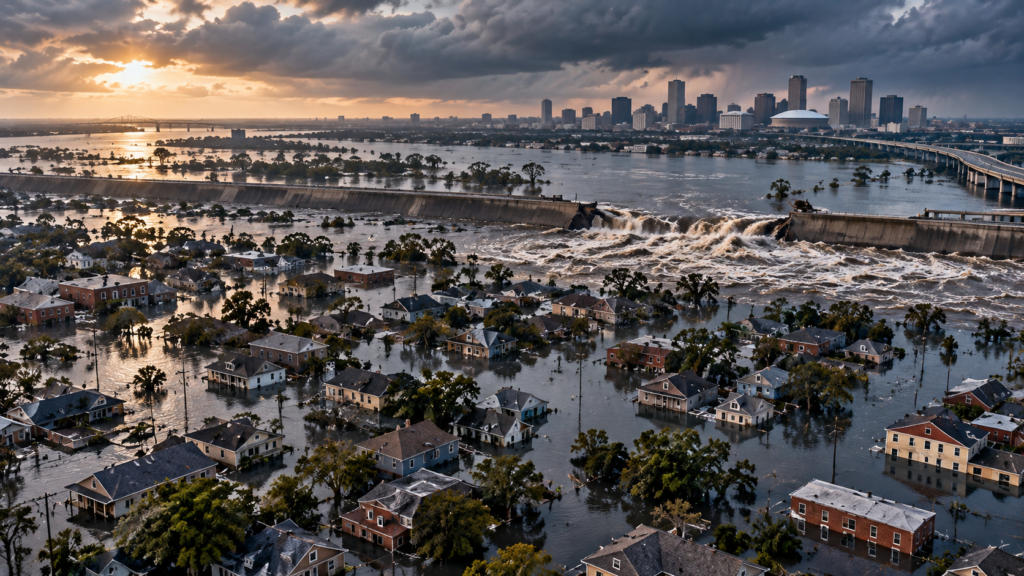
Surge inundated Gulf Coast communities, destroying homes, roads and public infrastructure in Louisiana and Mississippi. In low-lying New Orleans, breaches and overtopping of floodwalls and levees allowed large amounts of water into neighborhoods. The U.S. Army Corps of Engineers documented roughly 50 breaches in the regional protection system and estimated that 80% of the city flooded. Some locations experienced several metres of water.
Rainfall worsened conditions, but in many parts of New Orleans the most consequential mechanism was water entering through compromised flood-protection infrastructure.
Why did the levees fail?
Post-disaster investigations identified multiple mechanisms: overtopping and erosion, seepage, geotechnical weaknesses and design or construction shortcomings in particular structures. The failures were not a single isolated breach or simply unavoidable consequences of high winds. Investigations by the Corps of Engineers and the U.S. Geological Survey showed how engineering vulnerabilities amplified the extreme natural hazard.
Deaths and damage: why numbers vary
The National Hurricane Center’s report revised January 4, 2023 lists 1,392 fatalities: 520 direct, 565 indirect and 307 with indeterminate cause. Some older agency pages still quote around 1,800 deaths, reflecting earlier accounting. This article uses the more recent NHC assessment.
NOAA estimated damage at approximately $125 billion in unadjusted 2005 US dollars. Beyond material losses, mass displacement and the interruption of health care, housing, transport and essential services were especially severe for vulnerable communities.
Warnings, evacuation and unequal exposure
Katrina demonstrated that forecasting a hurricane’s track is not enough to protect a whole city. Effective risk reduction depends on reliable defenses, accessible evacuation transportation and shelter, coordination among agencies and clear warnings that reach residents who cannot relocate on their own.
What changed after Katrina?
The disaster prompted major reviews of engineering design, emergency management and risk communication. Flood defenses in the New Orleans region were repaired and strengthened through subsequent programs overseen by the Corps of Engineers. No protective structure can eliminate flood risk altogether, however.
Four lasting lessons
- A hurricane category does not capture all hazards: surge, rainfall, storm size and exposure can be catastrophic even as maximum winds weaken.
- Infrastructure matters: damaged, undersized or poorly designed protection can magnify impacts.
- Evacuation must be inclusive: planning needs to reach people without vehicles, older people, patients and low-income households.
- Historical figures are revised: use current official accounting and explain conflicting older totals.
Frequently asked questions
Was Katrina Category 5 when it struck Louisiana?
No. Katrina peaked at Category 5 over the Gulf but struck the northern Gulf Coast as a Category 3 hurricane. Its surge and enormous size remained exceptionally dangerous.
How much of New Orleans flooded?
The U.S. Army Corps of Engineers estimated about 80% of the city.
How many people died in Hurricane Katrina?
The revised 2023 NHC report attributes 1,392 deaths, including direct, indirect and indeterminate causes.
Official sources and further reading
- NOAA/NHC: Hurricane Katrina Tropical Cyclone Report, revised in 2023
- National Weather Service: 20th anniversary historical review
- U.S. Army Corps of Engineers: Katrina and levee breaches
- USGS: LiDAR assessment of levee failures
Editorial review: October 24, 2026. Featured artwork is a conceptual reconstruction, not a photograph taken in 2005.