
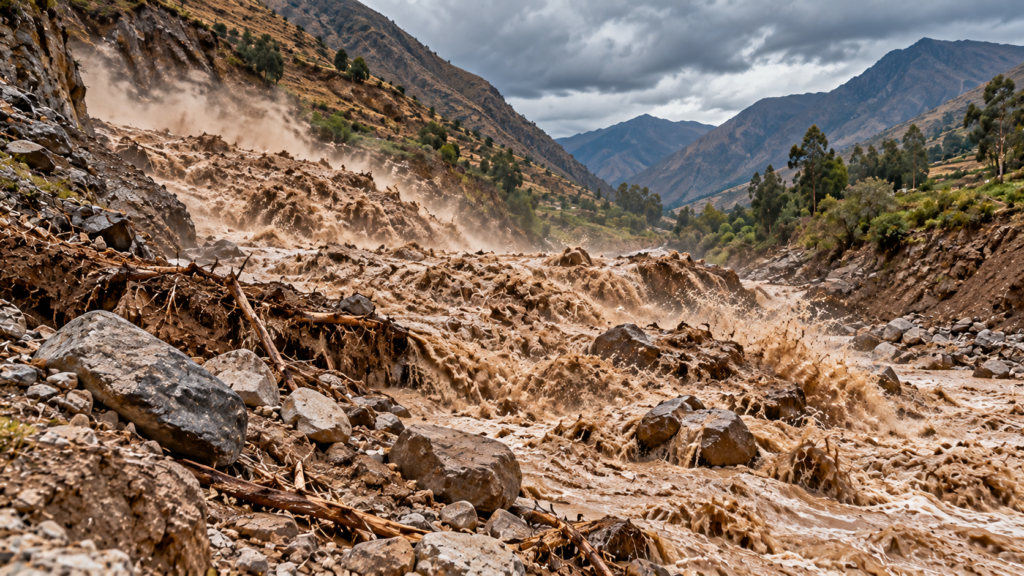
A landslide is the downhill movement of rock, soil or debris under gravity. The U.S. Geological Survey (USGS) explains that landslides include several movement types, from rock falls and slides to fast-moving debris flows. In everyday American English, a water-rich flow may be called a mudslide, although geologists prefer more precise terms based on the material and movement involved.
What causes a landslide?
Slope failure occurs when forces pulling material downhill exceed the resistance of the ground. Heavy rain, snowmelt, earthquakes, erosion, volcanic activity and changes to a hillside can all contribute. Most landslides involve a combination of conditions rather than one universal cause.
Landslide, mudslide and debris flow: key differences
| Term | What it describes | Typical hazard |
|---|---|---|
| Landslide | Broad category of downslope movement of earth, rock or debris | Ground movement, burial and infrastructure damage |
| Debris flow | Rapid movement of water mixed with soil, rocks and debris | High-speed impacts, burial and dangerous channel flows |
| Mudslide | Popular but imprecise term often used for muddy flows and landslides | Actual hazard depends on the specific process |
| Rockfall | Rock breaking loose and falling from steep terrain | Sudden falling or bouncing rocks |
What is a debris flow?
Debris flows are among the most dangerous rapid landslides because they can move downhill through gullies while carrying boulders, uprooted trees and large amounts of sediment. According to USGS, they may exceed 35 mph (56 km/h) and can travel several miles in steep channels. Intense rainfall or rapid snowmelt are common triggers.
How can wildfires increase debris-flow danger?
Burned hillsides may temporarily have less vegetation and reduced capacity to absorb rain. Intense rain over burned terrain can produce dangerous debris flows, even outside the burned area. Our separate guide explains what wildfires are and how they spread. The presence of a recent fire does not guarantee a debris flow, but it can raise concern during subsequent storms.
Where do landslides happen in the United States?
Landslides and debris flows can occur in mountainous, coastal and other unstable terrain across the country. USGS notes that debris flows have been recorded in all 50 states and U.S. territories. Actual risk varies by slope, geology, past slides, rainfall and land use. Local hazard maps and alerts are more useful for immediate decisions than national generalizations.
Warning signs and what to do
New ground cracks, tilting trees, suddenly muddy streams, unusual rumbling or a change in how water drains can sometimes signal slope movement. However, fast landslides and debris flows can occur without obvious warning. Avoid steep gullies and unstable slopes during intense rain; follow local emergency instructions and evacuate promptly if ordered. Never try to drive or walk through a moving debris flow.
Can landslides be prevented?
Risk can sometimes be reduced through hazard-aware land-use planning, engineered slope stabilization, appropriate drainage, monitoring and avoiding development on unstable ground. No single method eliminates the risk. Communities should consult qualified geotechnical specialists and public agencies about particular slopes.
What does the Peruvian word ‘huaico’ mean?
In Peru, a huaico (also spelled huayco) commonly refers to a fast-moving debris flow carrying mud, water and rocks down a slope or through a mountain stream channel. This is a useful regional example of a debris-flow hazard, not a synonym for every kind of landslide. Learn about related rainfall hazards in our guide to causes of floods.
Frequently asked questions
Is a mudslide the same as a landslide?
Not exactly. Landslide is a broad scientific category; mudslide is an informal label often applied to muddy debris flows or other slope movements.
Can a landslide happen after a wildfire?
Yes. Heavy rain on recently burned slopes can trigger debris flows, but an individual event depends on terrain, rainfall and local conditions.
Can landslides occur without rain?
Yes. Earthquakes, erosion, volcanic activity and human alterations can also destabilize slopes.
Official scientific sources
- USGS: What is a landslide and what causes one?
- USGS: What is a debris flow?
- USGS: Landslide terminology and definitions
- Ready.gov: Landslides and debris flows
Educational reference, not a current emergency alert. Featured artwork is a conceptual illustration rather than a photograph of a specific disaster.

