
Geological faults are fractures or zones of fractures in Earth’s crust where blocks of rock have moved relative to one another. Some faults accumulate stress over long periods and can release that energy suddenly in the form of earthquakes.
Faults do not all move in the same way. Depending on the direction of displacement, they can be normal, reverse, strike-slip or oblique-slip faults. Understanding these differences helps explain how tectonic plates deform and why different earthquake mechanisms occur in different settings.
What is a geological fault?
A fault is a break in rock accompanied by displacement. If a fracture exists but there has been no significant relative movement, geologists generally describe it as a joint or fracture rather than a fault.
Faults can range from very small structures to systems hundreds or thousands of kilometers long.
How geological faults form
Rocks in Earth’s crust are subjected to stresses created by plate motion and other geological processes. When stress exceeds the strength of the rock, the crust may fracture and the blocks may move.
- Extension: rocks are pulled apart.
- Compression: rocks are pushed together.
- Shear: blocks move laterally past one another.
Main types of geological faults
| Fault type | Main movement | Typical stress |
|---|---|---|
| Normal | The hanging wall moves downward relative to the footwall | Extension |
| Reverse or thrust | The hanging wall moves upward over the footwall | Compression |
| Strike-slip | Blocks move mainly horizontally past each other | Shear |
| Oblique-slip | Combines vertical and horizontal movement | Mixed |
Normal fault
In a normal fault, the hanging wall moves downward relative to the footwall. Normal faulting is commonly associated with crustal extension.
Reverse and thrust faults
In a reverse fault, the hanging wall moves upward relative to the footwall. These faults form mainly in compressional environments.
A low-angle reverse fault is commonly called a thrust fault. Large thrust faults are especially important in convergent and subduction zones.
Strike-slip fault
Strike-slip faults involve mainly horizontal movement. The San Andreas Fault in California is a well-known example of a right-lateral strike-slip fault.
Oblique-slip fault
Many real faults combine vertical and horizontal components of movement. These are classified as oblique-slip faults.
Main parts of a fault
- Fault plane: the surface along which displacement occurs.
- Fault trace: the line where the fault plane intersects Earth’s surface.
- Hanging wall: the block above an inclined fault plane.
- Footwall: the block below the fault plane.
- Slip: the relative displacement between the blocks.
What is the relationship between faults and earthquakes?
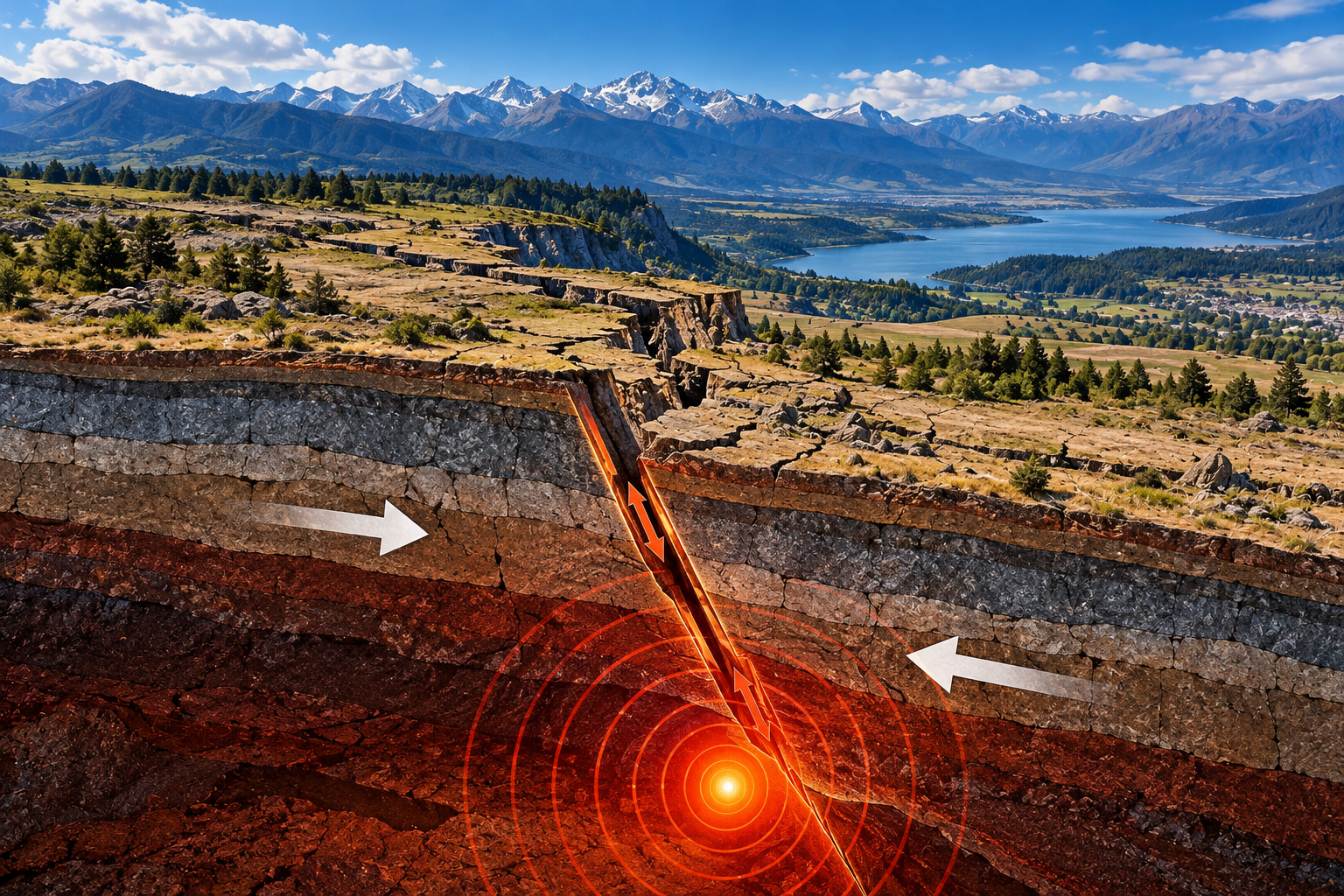
Many tectonic earthquakes occur when a locked section of a fault suddenly slips. While the fault remains stuck because of friction, elastic strain can build in the surrounding rocks.
When the stress becomes large enough to overcome resistance on the fault, sudden slip releases energy that travels through the Earth as seismic waves.
Do all faults produce earthquakes?
No. Some faults move slowly through creep, some may remain quiet for long periods, and many old fractures are no longer subjected to stresses capable of producing significant earthquakes.
The existence of a fault does not mean an earthquake is imminent.
Active and inactive faults
The term active fault is generally used for faults that have moved in geologically recent time and may move again, although exact classification criteria vary by region and scientific agency.
Paleoseismology studies old sediments, displaced layers and other geological evidence to reconstruct prehistoric earthquakes.
Is a fault the same as a plate boundary?
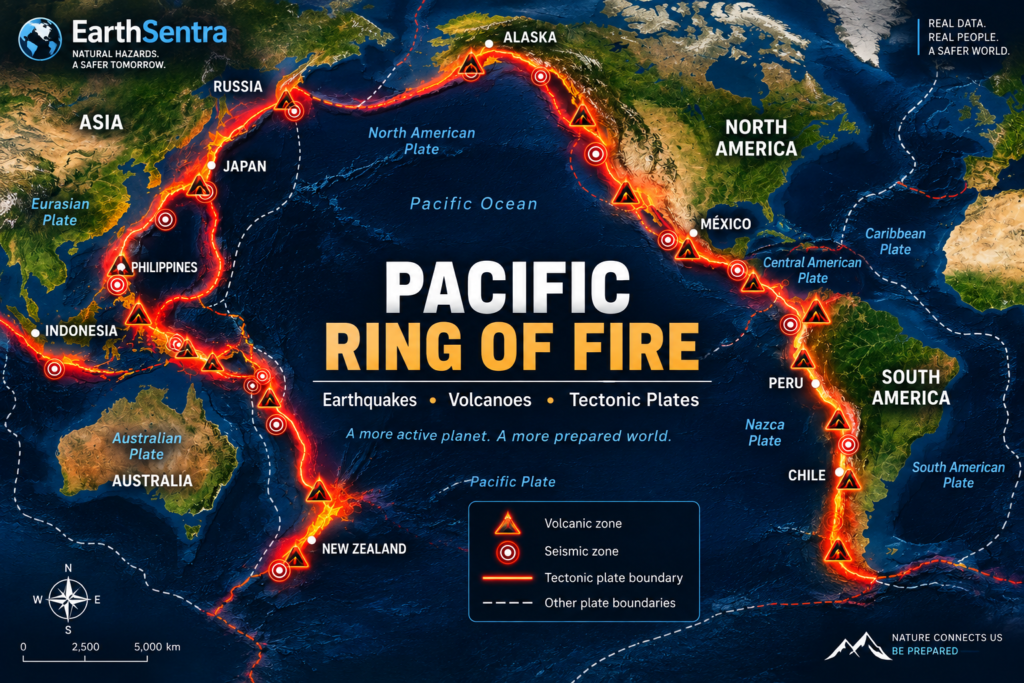
No. A plate boundary is a broad region where two tectonic plates interact. Many individual faults can exist within that boundary zone.
Faults can also occur inside tectonic plates, which is why intraplate earthquakes are possible.
Examples of major fault systems
- San Andreas Fault: a major strike-slip system between the Pacific and North American plates.
- North Anatolian Fault: a major strike-slip fault system in Turkey.
- Alpine Fault: a major tectonic structure in New Zealand.
- Subduction megathrusts: enormous reverse faults capable of producing very large earthquakes and, in some cases, tsunamis.
Does fault size control earthquake magnitude?
Rupture size is one of the key controls. In general, larger earthquakes involve a larger fault area and more slip, although rock rigidity also matters.
Seismologists use seismic moment to describe the physical size of a rupture, and moment magnitude (Mw) is derived from that measurement.
Can scientists predict when a fault will rupture?
There is currently no scientifically reliable method for predicting the exact date, time and location of a future earthquake. Scientists can identify active faults, study their histories and estimate earthquake probabilities over specified time periods.
Faults and seismic risk
The presence of an active fault is only one part of seismic risk. Distance from populated areas, earthquake depth, local soils, building quality and preparedness all influence potential damage.
Learn more in Why Do Earthquakes Happen?, our guide to earthquake epicenters and hypocenters, and the Earthquakes Today monitor.
Frequently asked questions
What is the difference between a normal and reverse fault?
In a normal fault, the hanging wall moves downward because of extension. In a reverse fault, it moves upward because of compression.
What is a strike-slip fault?
It is a fault where the two blocks move primarily horizontally past one another.
Can an old fault become active again?
Yes. Some old structures can be reactivated if the regional stress field changes, although this depends on local geology.
Are all faults visible at the surface?
No. Some are buried beneath sediments and do not produce an obvious surface rupture. Geological and geophysical methods can be used to identify them.
Scientific sources
- U.S. Geological Survey — What is a fault and what are the different types?
- U.S. Geological Survey — Relationship between faults and earthquakes
- U.S. Geological Survey — Finite Faults
In summary: geological faults are fractures with displacement in Earth’s crust. Their motion can be normal, reverse, strike-slip or oblique, and many are directly related to tectonic earthquakes. Studying their geometry and history helps scientists evaluate earthquake hazards.