
Why do earthquakes happen? This guide explains how faults release energy and how tectonic, volcanic and human-induced earthquakes differ.
Earthquakes happen when rocks suddenly release stored energy, usually by slipping along a fault. The release creates seismic waves that travel through the ground. Understanding why the Earth shakes means separating the earthquake’s cause, the fault’s movement and the shaking experienced at a particular location.
Why do earthquakes happen? The main cause
The main explanation is the movement of tectonic plates. They move slowly, but friction can keep parts of a fault locked. As movement continues around the locked section, rocks deform and stress builds. When the fault slips, an earthquake can occur.
The process begins below the surface. Our guide to the earthquake epicenter and hypocenter explains how to locate its starting point.
What types of faults produce earthquakes?
A fault is a fracture surface along which blocks of rock move relative to each other. Three common categories describe the dominant movement:
- Normal faults: the block above the fault plane moves downward relative to the other block, associated with extension.
- Reverse and thrust faults: that block moves upward, associated with compression.
- Strike-slip faults: the blocks move sideways past each other.
These categories describe fault movement. They do not, by themselves, determine how much damage an earthquake will cause.
Types of earthquakes by their origin
Tectonic earthquakes
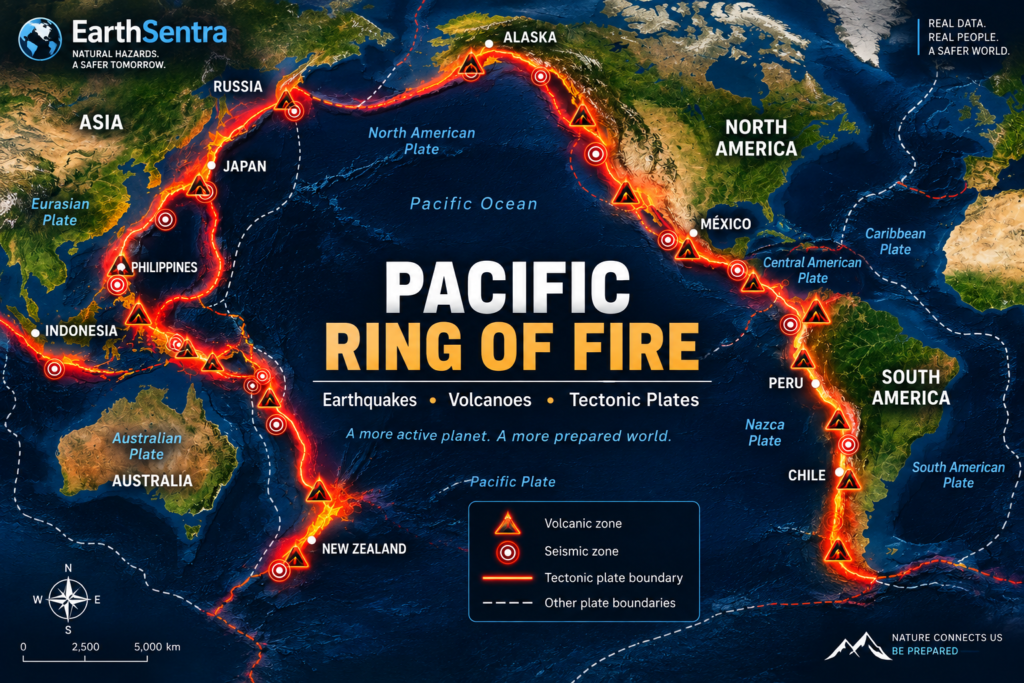
These are associated with rock deformation and movement caused by tectonic processes. Many earthquake zones lie along plate boundaries, where plates pull apart, converge or slide past one another. The Pacific Ring of Fire provides a useful example of this pattern.
Earthquakes associated with volcanoes
Moving magma and other fluids can change stresses and fracture rock. Volcano observatories examine these seismic signals alongside other measurements. An earthquake near a volcano is not enough, on its own, to conclude that an eruption will follow.
Human-induced seismicity
Some activities can change conditions on existing faults. A documented example is the injection of large volumes of wastewater deep underground. Connecting a particular operation to an earthquake requires investigation; proximity alone does not establish the cause.
Why does the same earthquake feel different in different places?
The source of an earthquake and its local effects are separate questions. Depth, distance from the rupture and ground conditions influence shaking. Soft sediments can amplify shaking compared with firm bedrock.
This is why earthquake magnitude and intensity are different: one describes the earthquake’s size, while the other describes its effects at a location.
Frequently asked questions about earthquake causes
Do heat or rain cause earthquakes?
There is no distinctive “earthquake weather” that lets us anticipate earthquakes from the sky or temperature. Explanations of an event’s origin need geological and seismic evidence.
Can scientists predict exactly when an earthquake will happen?
There is no reliable method to announce the exact date, location and magnitude of a future earthquake. Hazard assessments and probability estimates support preparation, but they are not precise predictions.
Understanding the causes and preparing
Knowing why earthquakes happen helps you interpret reports and question rumors. For practical guidance, read what to do during an earthquake and follow instructions from your local authorities.