
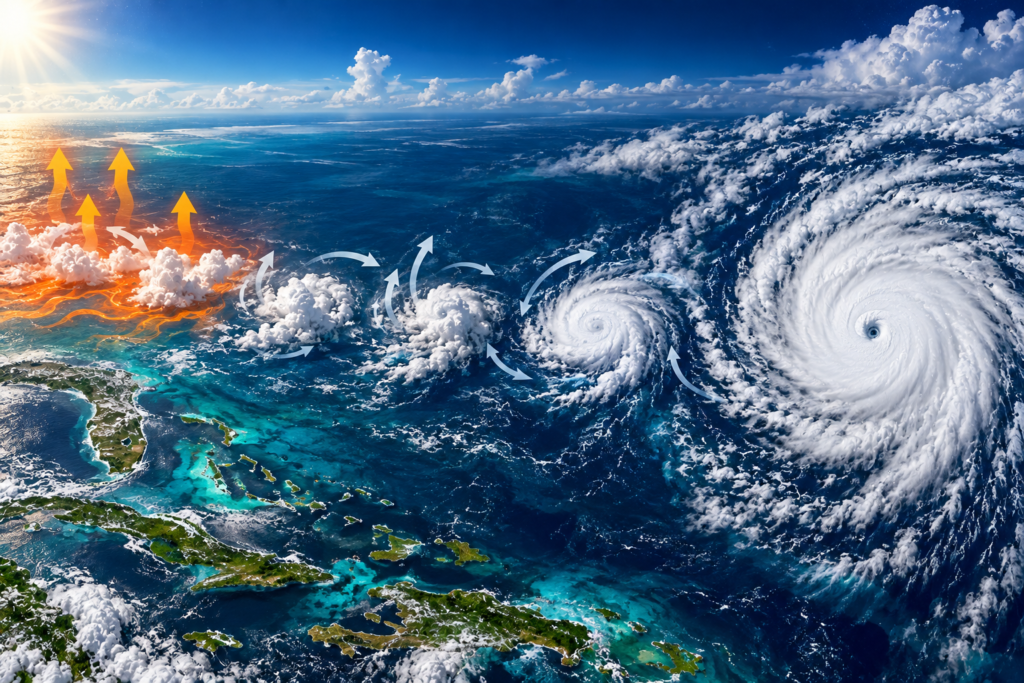
Hurricane formation begins long before a well-defined eye appears on satellite imagery. A favorable combination of warm ocean water, moist air, low vertical wind shear and enough Coriolis force is needed for thunderstorms to organize around a low-pressure center.
If those conditions persist, a tropical disturbance can develop into a tropical depression, then a tropical storm and eventually a hurricane once its sustained winds reach the required threshold. The process is not automatic: many disturbances never become intense tropical cyclones.
This guide explains how hurricanes form step by step, what conditions they need, how they draw energy from the ocean and why some systems intensify while others weaken.
What is a hurricane
A hurricane is an intense tropical cyclone with an organized circulation around a low-pressure center and sustained winds of at least 119 km/h (74 mph). The term “hurricane” is mainly used in the North Atlantic and northeastern Pacific. Equivalent systems are called typhoons or tropical cyclones in other regions.
EarthSentra explains those regional naming differences in Hurricane, Typhoon or Cyclone: What’s the Difference?.
Conditions needed for hurricane formation
| Condition | Why it matters |
|---|---|
| Warm ocean water | Provides heat and moisture; a sea-surface temperature near or above 26.5 °C is commonly used as an educational reference when warm water extends deep enough. |
| High atmospheric moisture | Supports deep convection and persistent thunderstorms. |
| Low vertical wind shear | Allows the storm’s circulation and thunderstorms to remain vertically aligned. |
| Pre-existing disturbance | Provides an initial area of low pressure, clouds and thunderstorms. |
| Sufficient Coriolis force | Helps establish rotation, which is why tropical cyclones rarely form directly on the equator. |
How a hurricane forms step by step
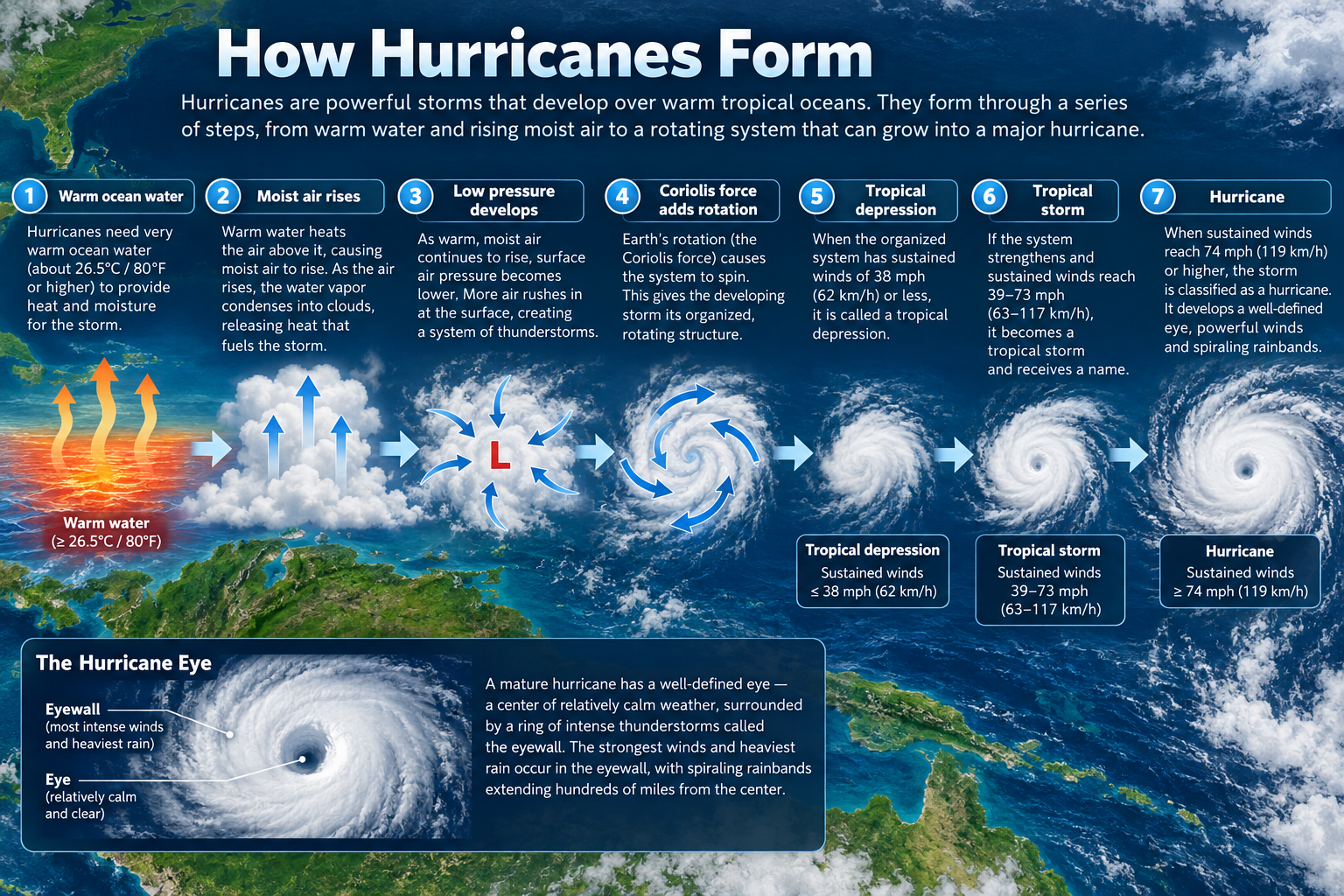
1. The ocean supplies heat and moisture
Warm sea-surface water increases evaporation. Warm, moist air near the ocean rises while surrounding air moves toward the lower pressure near the developing system.
The often-cited 26.5 °C threshold is a useful reference, not an exact switch. The depth of warm water and the state of the atmosphere also matter.
2. Moist air rises and thunderstorms develop
As moist air rises, it cools and water vapor condenses into clouds and rain. Condensation releases latent heat, warming the storm’s interior and helping air continue to rise.
This cycle of evaporation, ascent, condensation and heat release is one of the main energy sources of a tropical cyclone.
3. Surface pressure falls
As air rises, surface pressure decreases. More air flows inward, bringing additional moisture from the ocean. If thunderstorms remain scattered, the system may dissipate. If they begin organizing around a common center, the disturbance can strengthen.
4. Coriolis force helps establish rotation
Earth’s rotation deflects moving air. Tropical cyclones rotate counterclockwise in the Northern Hemisphere and clockwise in the Southern Hemisphere.
Near the equator, the Coriolis effect is too weak to support organized tropical cyclone rotation easily, so formation there is very rare.
5. Tropical disturbance to tropical depression
Once a closed surface circulation becomes established and thunderstorms organize around the center, the system can be classified as a tropical depression.
At this stage, sustained winds are still below tropical-storm strength.
6. Tropical depression to tropical storm
When sustained winds reach about 63 km/h (39 mph), the system becomes a tropical storm and is normally assigned an official name for its ocean basin.
Rainbands and the overall circulation may become increasingly organized, although structure varies widely from one storm to another.
7. When it becomes a hurricane
In the Atlantic and northeastern Pacific, a tropical storm becomes a hurricane when maximum sustained winds reach at least 119 km/h (74 mph).
From that point, the Saffir-Simpson Hurricane Wind Scale classifies hurricanes from Category 1 to 5 according to maximum sustained wind speed. The scale does not directly measure rainfall, flooding or storm surge. See EarthSentra’s guide to hurricane categories.
How a hurricane gets its energy
A hurricane can be viewed as a huge heat engine powered mainly by ocean warmth and the release of heat when water vapor condenses.
Warm, moist air flows inward near the surface, rises in thunderstorms, releases heat as moisture condenses, and spreads outward high in the atmosphere. As long as the storm can maintain this cycle over sufficiently warm water, it can sustain or increase its intensity.
The role of vertical wind shear
Vertical wind shear is the change in wind speed or direction with height. Strong shear can tilt the circulation, separate thunderstorms from the center and disrupt organization.
Relatively weak shear allows deep convection to remain closer to the center and supports a more vertically aligned structure.
How the eye forms
Strong tropical cyclones can develop an eye, a relatively calm central region surrounded by the eyewall, where some of the strongest winds and heaviest rainfall usually occur.
Outside the eyewall, spiral rainbands can extend hundreds of kilometers. A visible eye often indicates a well-organized cyclone, but eye size alone does not determine the storm’s overall danger.
Why some hurricanes rapidly intensify
Rapid intensification occurs when maximum sustained wind speed increases substantially over a short period. Very warm water, high ocean heat content, abundant moisture and weak wind shear can all contribute.
However, rapid intensification depends on a complex combination of oceanic and atmospheric processes and cannot be predicted from sea-surface temperature alone.
What weakens a hurricane
Hurricanes usually weaken when they lose access to their energy source or encounter an unfavorable atmosphere. Common weakening factors include:
- moving over land;
- cooler ocean water;
- strong vertical wind shear;
- dry air;
- interaction with other weather systems;
- cool-water upwelling caused by the cyclone itself.
Landfall does not mean the danger ends immediately. A weakening cyclone can still produce destructive rainfall, flooding, storm surge, tornadoes and strong winds far inland.
What controls a hurricane’s track
Tropical cyclones are steered by large-scale wind patterns, high- and low-pressure systems and atmospheric currents at different levels.
Forecast tracks are updated constantly because even modest changes in those steering patterns can alter a storm’s projected position several days later.
Tropical depression, tropical storm and hurricane
| Stage | Approximate sustained wind | Characteristics |
|---|---|---|
| Tropical depression | Up to 62 km/h (38 mph) | Closed circulation with organized thunderstorms |
| Tropical storm | 63–118 km/h (39–73 mph) | Named system with a more organized circulation |
| Hurricane | 119 km/h (74 mph) or more | Intense tropical cyclone classified as Category 1–5 on the Saffir-Simpson scale |
How long does a hurricane take to form
There is no fixed timetable. Some disturbances organize over a few days, while others remain poorly organized for much longer or never develop at all.
The outcome depends on atmospheric stability, ocean temperature, moisture, wind shear, the disturbance’s initial structure and its interaction with the surrounding environment.
Where hurricanes form
Tropical cyclones develop in several warm ocean basins. The term “hurricane” is mainly used in the Atlantic and northeastern Pacific, “typhoon” in the northwestern Pacific and “tropical cyclone” in other basins.
For active storms and current tracks, visit Hurricanes Today.
Frequently asked questions
Does 26.5 °C ocean water guarantee hurricane formation?
No. Warm water is an important favorable condition, but sufficient moisture, low wind shear, organization and other atmospheric factors are also needed.
Can a hurricane form directly on the equator?
It is extremely rare because the Coriolis effect is too weak near the equator to support the required rotation easily.
Do all tropical cyclones develop an eye?
No. A well-defined eye generally forms only in sufficiently intense and organized systems.
Does a hurricane always weaken after landfall?
Usually, because it loses its direct supply of ocean heat and moisture and experiences more surface friction. Its rainfall and flooding hazards can still remain severe inland.
Scientific sources
- National Hurricane Center — Saffir-Simpson Hurricane Wind Scale.
- NOAA JetStream — Tropical Cyclone Introduction.
- NOAA AOML — Hurricane Research Division FAQ.
In summary: hurricanes form when a tropical disturbance organizes over warm water in a moist atmosphere with relatively weak vertical wind shear. The ocean supplies energy, rising moist air powers thunderstorms and Earth’s rotation supports circulation. If favorable conditions persist, the system can develop from a tropical depression into a hurricane.

