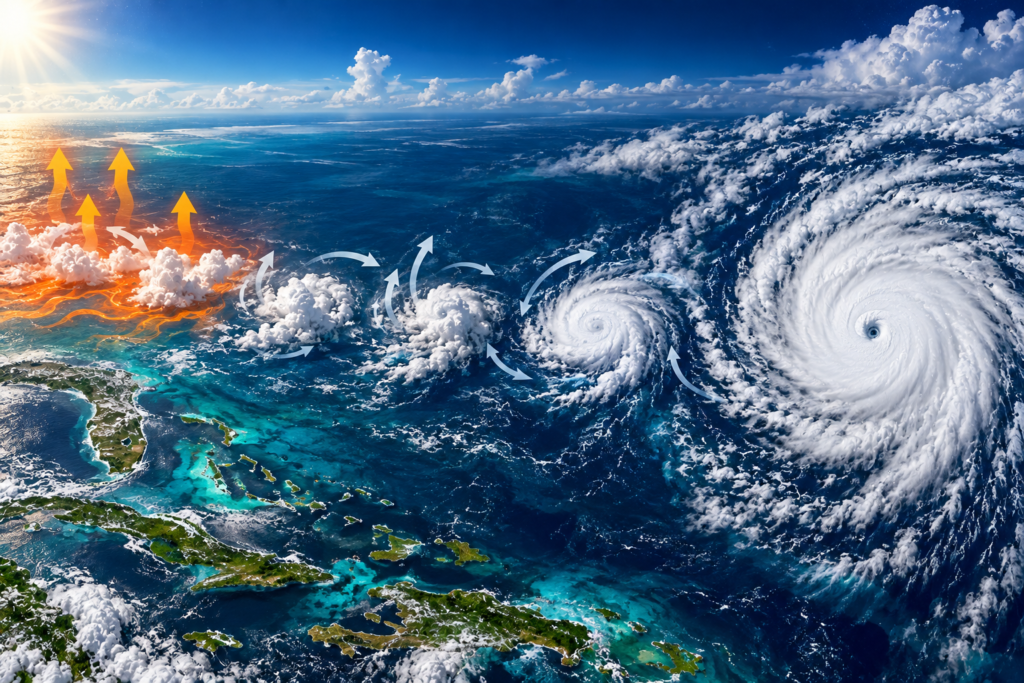

The hurricane, typhoon and cyclone difference is mainly about where the storm occurs and the terminology used by meteorological agencies. All three terms belong to the same family of weather systems: tropical cyclones.
But saying they are simply “exactly the same” misses an important detail. Ocean basins use different names, thresholds and classification systems. A powerful tropical cyclone may therefore be called a hurricane in the Atlantic and a typhoon in the western North Pacific.
For current activity, EarthSentra provides live tracking of hurricanes, typhoons and tropical cyclones from the official sources currently integrated.
Hurricane, typhoon and cyclone difference: the short answer
Hurricane: the term used for intense tropical cyclones in the North Atlantic and the eastern and central North Pacific.
Typhoon: the term used for intense tropical cyclones in the western North Pacific, the basin that includes Japan, the Philippines and parts of the Chinese coast.
Tropical cyclone: the generic meteorological term for this family of storms and part of the regional terminology used across several areas of the Indian Ocean and South Pacific.
The World Meteorological Organization explains that terminology varies by ocean basin. NOAA makes the same basic distinction: hurricanes and typhoons are the same weather phenomenon, generically called tropical cyclones.
What is a tropical cyclone?
A tropical cyclone is an organized, rotating low-pressure system that develops over tropical or subtropical waters. It draws much of its energy from the warm ocean and can produce destructive winds, torrential rainfall, high waves, storm surge and flooding.
When conditions remain favorable, a disturbance can become increasingly organized and pass through different intensity stages. The exact names for those stages depend on the responsible agency and basin.
Where are they called hurricanes?
The term hurricane is used primarily in the North Atlantic, Caribbean, Gulf of Mexico, and eastern and central North Pacific. Under NOAA terminology, a tropical cyclone reaches hurricane intensity when maximum sustained winds reach 64 knots, about 119 km/h or 74 mph.
These regions commonly use the Saffir-Simpson Hurricane Wind Scale, which ranks hurricanes from Category 1 to Category 5 according to maximum sustained wind speed. The category is not a complete measure of every hazard: rainfall, flooding and storm surge can be life-threatening even when the wind category is not the highest.
Where are they called typhoons?
In the western North Pacific, intense tropical cyclones are internationally called typhoons. This is the basin that frequently affects Japan, the Philippines, Taiwan, China and other parts of East Asia.
The Japan Meteorological Agency (JMA) uses Tropical Depression, Tropical Storm, Severe Tropical Storm and Typhoon in its international information. In that international classification, Typhoon means maximum sustained winds of at least 64 knots.
An important detail about Japan
Japan illustrates why international comparisons require care. In Japanese domestic terminology, JMA uses taifu for a tropical cyclone in the western North Pacific or South China Sea with maximum winds of about 34 knots or more. In its international products, however, JMA separates Tropical Storm, Severe Tropical Storm and Typhoon, reserving the international Typhoon category for 64 knots or more.
JMA also uses 10-minute sustained wind averages, while U.S. agencies commonly use 1-minute averages. Wind figures from different agencies therefore should not always be compared as though they were measured in exactly the same way.
Where is the word cyclone used?
Tropical cyclone is the generic term for the entire family. Regional classifications can also include terms such as tropical cyclone, severe tropical cyclone, cyclonic storm and severe cyclonic storm.
Across parts of the Indian Ocean and South Pacific, cyclone-based terminology is therefore more common than hurricane or typhoon. The exact operational term depends on the regional meteorological center responsible for that basin.
Does the storm change type when it crosses into another region?
It does not physically become a different kind of weather system simply by crossing a geographic boundary. What may change is the terminology used to describe it. The same tropical cyclone can cross meteorological areas and be described using different regional conventions.
Its intensity can also change during the journey as the storm strengthens, weakens or eventually loses its tropical characteristics.
Hurricanes, typhoons and cyclones are not tornadoes
A tornado is a different phenomenon. Tropical cyclones are large atmospheric systems that form over warm oceans and can span hundreds of kilometers. A tornado is a much smaller rotating column of air connected to a thunderstorm and the surface.
Tropical cyclones can produce tornadoes, but that does not make the two phenomena equivalent.
Why do tropical cyclones get names?
Names make warnings, tracking and communication easier, especially when several storms are active at the same time. The World Meteorological Organization coordinates regional procedures, and naming systems differ among basins.
Names associated with particularly destructive cyclones can be retired from the relevant regional lists.
The name is not the most important part of the danger
Assessing tropical-cyclone risk requires more than knowing whether a storm is called a hurricane or typhoon. Track, size, wind speed, rainfall, waves, storm surge, flood risk and official warnings all matter.
EarthSentra provides a current tropical cyclone map and tracking page. Tracking information does not replace territorial warnings or evacuation instructions from the responsible authorities.
Frequently asked questions
Is a typhoon stronger than a hurricane?
Not because of the name. Hurricane and typhoon mainly identify the basin. Compare the storm’s intensity data and account for the measurement method used by each agency.
Why does Japan say typhoon while the United States says hurricane?
Japan borders the western North Pacific, where typhoon terminology is used. Hurricane terminology is used in the North Atlantic and the eastern and central North Pacific.
Is tropical cyclone the general scientific term?
Yes. Tropical cyclone is the generic meteorological term for this family of storms, while operational terminology varies by basin.