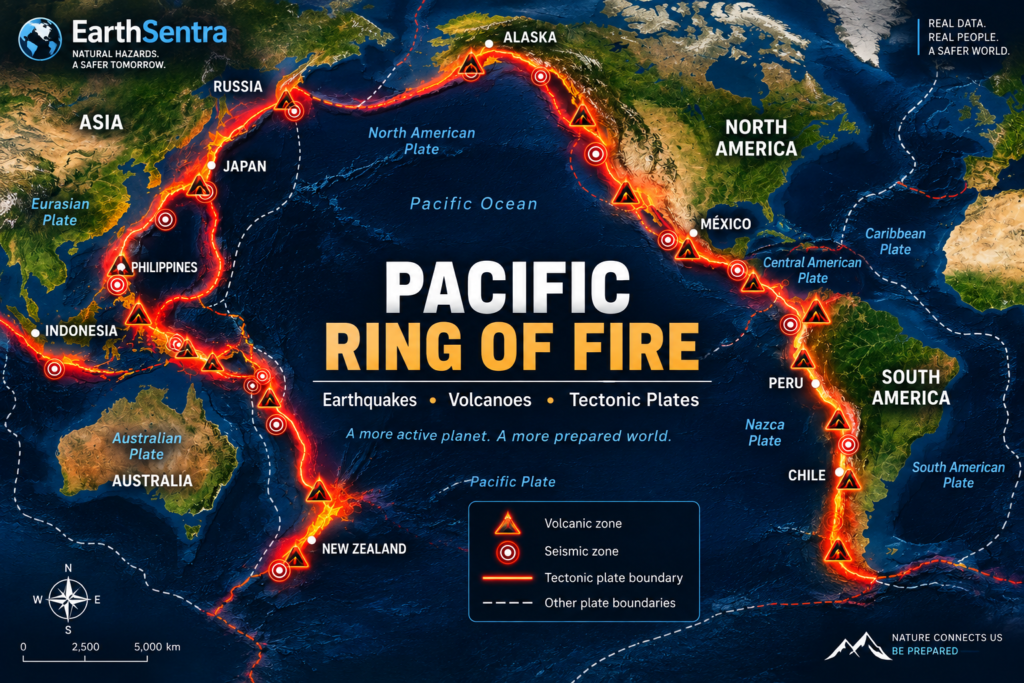

When volcanic activity increases, scientific agencies may change a volcano’s alert level. Green, Yellow, Orange, Red, Level 2, Level 3, Waspada, Watch, and Warning are some of the terms used around the world.
But there is one essential rule for interpreting this information correctly:
volcano alert levels do not mean exactly the same thing in every country.
Each monitoring agency establishes its own system based on observed activity, expected hazards, potentially affected areas, and the actions that authorities and communities may need to take.
For this reason, Level 2 in Japan should not automatically be considered equivalent to Level II in Indonesia, just as a Yellow alert may have different definitions depending on the country.
EarthSentra preserves information from official monitoring agencies while organizing it in a way that makes international volcanic activity easier to understand.
You can check current volcanic activity and official alerts on EarthSentra.
What Is a Volcano Alert Level?
A volcano alert level is a communication tool used to describe the current status of a volcano and help determine what precautions may be necessary.
If official advisories include ashfall, our guide to volcanic ash protection explains the associated hazards and precautions.
Volcano observatories analyze many different types of information, including:
- seismic activity;
- ground deformation;
- gas emissions;
- temperature changes;
- explosions;
- ash emissions;
- visual observations and cameras;
- satellite information.
A change in one of these parameters does not automatically mean that an eruption will occur.
Scientists analyze the combination of observations, the volcano’s previous behavior, and possible future scenarios before changing an alert level.
A Volcano Alert Is Not an Exact Prediction
An elevated alert does not necessarily mean that scientists know exactly when an eruption will occur.
Volcanoes are complex systems.
A volcano may show signs of unrest and later return to background conditions without producing a major eruption.
It may also remain at an elevated alert level for an extended period.
Alert levels should therefore be understood as assessments of volcanic conditions and hazards based on the available evidence, rather than as eruption countdowns.
Japan: Five Volcanic Alert Levels
The Japan Meteorological Agency (JMA) uses a five-level system at volcanoes where the Volcanic Alert Level framework is applied.
An important feature of the Japanese system is that the levels relate not only to volcanic activity but also to areas requiring caution and actions that people may need to take.
In simplified form:
Level 1 — Potential for increased activity
People should remain aware that the volcano is active.
Level 2 — Do not approach the crater
Hazardous activity may affect areas around the crater, and access restrictions may be established.
Level 3 — Do not approach the volcano
Potentially dangerous activity may affect a wider area, and access to the mountain or volcanic zone can be restricted.
Level 4 — Evacuation of vulnerable people, etc.
Hazards may threaten residential areas, and people who require additional time or assistance to evacuate may need to begin doing so according to official instructions.
Level 5 — Evacuation
Significant danger exists for residential areas and evacuation from threatened zones is required.
Not every Japanese volcano necessarily uses this five-level scale. JMA also issues volcanic warnings and forecasts for volcanoes where Volcanic Alert Levels are not applied.
This distinction is important when comparing Japan with volcanic activity in other countries.
Indonesia: Normal, Waspada, Siaga and Awas
Indonesia contains one of the world’s largest concentrations of active volcanoes and uses a four-level volcanic activity system.
PVMBG and Indonesia’s geological authorities use the following official designations:
Level I — Normal
Volcanic activity remains within the conditions considered normal for the volcano.
Level II — Waspada
Activity has changed from normal background conditions and requires increased attention and monitoring.
Level III — Siaga
Volcanic activity has increased significantly and requires a higher state of preparedness and monitoring.
Level IV — Awas
This is the highest level in the Indonesian system and represents the maximum volcanic alert status.
The Indonesian terms have specific meanings within the country’s official framework. Replacing them with a supposedly equivalent international color or number can remove important context.
For this reason, EarthSentra preserves the original official level alongside its normalized presentation.
Current Indonesian information can be viewed on EarthSentra’s volcanoes in Indonesia page.
Chile: Green, Yellow, Orange and Red
In Chile, the Servicio Nacional de Geología y Minería (SERNAGEOMIN) monitors volcanic activity through its national volcanic monitoring network.
Its technical volcanic alert system uses four colors:
Green
Represents the baseline level or conditions consistent with the volcano’s established background behavior.
Yellow
Indicates changes from baseline conditions and increased monitoring parameters that require greater attention.
Orange
Represents a more elevated volcanic situation and greater potential for significant eruptive activity or an evolving eruption scenario.
Red
Represents the highest level of technical volcanic concern within the system.
An important distinction is that SERNAGEOMIN’s technical alert is a scientific assessment of volcanic conditions.
Civil protection decisions and instructions for communities are handled through the country’s emergency-management authorities.
A technical color should therefore not automatically be interpreted as an evacuation order.
Peru: A Four-Color Volcanic Alert System
The Instituto Geofísico del Perú (IGP), through the Centro Vulcanológico Nacional (CENVUL), uses a four-color volcanic alert system.
The levels are:
Green — Stability
The volcano’s dynamic behavior remains stable.
Yellow — Unrest
Changes or increases in activity have been observed and require increased attention and monitoring.
Orange — Ongoing eruption
Significant eruptive activity is occurring and may include explosions, ash emissions, or other volcanic phenomena.
Red — Critical eruption
Represents the most severe situation within the scale and may involve volcanic phenomena capable of seriously affecting nearby areas.
The color system helps authorities and communities understand changes in volcanic conditions quickly.
However, the official bulletin should also be consulted because two volcanoes displaying the same color may be experiencing very different volcanic phenomena.
Mexico: The Volcanic Alert Traffic Light
Mexico provides another good example of why numbers and colors should not be compared without context.
The system used for Popocatépetl has three main colors:
Green — Normal conditions
The volcano is in a relatively quiet stage.
Yellow — Alert
People should remain attentive and prepare for the possibility of evacuation if instructed. Yellow is divided into three phases, representing different degrees of volcanic activity.
Red — Alarm
Danger exists and communities must be ready to follow instructions from the authorities. Red is divided into two phases.
Therefore, simply reporting that a Mexican volcano is at “Yellow” may not provide enough information.
The phase is also important.
Mexico’s system demonstrates why EarthSentra should not automatically convert every national system into a single international numerical scale while discarding the original classification.
United States: Ground Alert Levels and Aviation Color Codes
The U.S. Geological Survey (USGS) uses a different approach.
For hazards affecting people and infrastructure on the ground, USGS uses four Volcano Alert Levels:
NORMAL
The volcano is in its typical background, non-eruptive state.
ADVISORY
The volcano is showing signs of elevated unrest above known background conditions.
WATCH
The volcano is exhibiting heightened or escalating unrest with an increased potential for eruption, or an eruption is underway but poses limited hazards.
WARNING
A hazardous eruption is imminent, underway, or suspected.
USGS also uses a separate system for aviation:
GREEN — YELLOW — ORANGE — RED
The Aviation Color Code is specifically designed to communicate volcanic hazards to aircraft, particularly hazards associated with airborne volcanic ash.
The ground-based alert level and aviation color code often move together, but they do not always have to match.
A volcano can pose different levels of danger to communities on the ground and to aircraft.
Why There Is No Single Worldwide Volcano Alert Scale
Volcanoes behave in very different ways.
One volcano may primarily produce lava flows.
Another may generate large ash columns.
Others can produce unstable lava domes, pyroclastic flows, lahars, or sudden explosions.
Human exposure also varies enormously.
One volcano may be located close to a major city, while another may be situated in a remote area.
National alert systems therefore reflect the characteristics of local volcanoes, monitoring capabilities, emergency-management structures, and exposed populations.
International standards exist for certain purposes, particularly aviation, but there is no single terrestrial volcanic alert scale that replaces all national systems.
The Problem With Comparing Colors Directly
Imagine two volcanoes:
Volcano A — Yellow
Volcano B — Yellow
This information alone does not demonstrate that both volcanoes present exactly the same level of hazard.
They may be located in different countries.
Their alert systems may use different criteria.
The observed volcanic phenomena may also be completely different.
Even within the same country, the geography and specific hazards associated with individual volcanoes can vary.
A better way to interpret volcanic alerts is:
authority → alert system → official level → explanation → recommendations
rather than looking only at the color.
How EarthSentra Handles International Alert Levels
EarthSentra integrates volcanic information from different scientific and government agencies.
Its purpose is not to replace the official national classification but to make international information easier to understand.
For this reason, it is useful to distinguish between:
Official level
The classification published by the responsible monitoring agency.
Normalized status
A representation used by EarthSentra to organize information from different national systems.
Observed activity
Phenomena detected through monitoring instruments and observations.
Confirmed eruption
Eruptive activity confirmed by the appropriate sources.
These concepts are not interchangeable.
A volcano may remain at an elevated alert level without producing a major eruption, while eruptive processes can occur under classifications whose exact meaning depends on the national system.
You can check current volcano alerts and activity to see how EarthSentra organizes information from different official sources.
Volcano Alert Levels Can Rise and Fall
Volcano alert systems do not move only upward.
Monitoring agencies may raise an alert when significant changes are detected and lower it again when activity declines sufficiently.
This is an important part of volcano monitoring.
A lower alert level does not mean that the volcano has stopped being an active volcano. It means that its current condition supports a different classification according to the criteria used by the responsible agency.
Alert levels are therefore dynamic assessments that can change as new monitoring information becomes available.
What to Do When a Volcano Alert Changes
The first step is to identify who issued the information.
Check the scientific institution or government authority responsible for monitoring the volcano.
Then determine:
- the previous alert level;
- the new alert level;
- what observations caused the change;
- which areas may be affected;
- what restrictions have been established;
- what recommendations authorities have issued.
A social media post stating that a volcano has “moved to Yellow” or “reached Level 3” does not provide enough context by itself.
The meaning of the official level and the accompanying bulletin are essential.
During an emergency, evacuation orders, exclusion zones, and safety instructions issued by competent local authorities always take priority over general interpretations of a volcanic alert level.
The Importance of Continuous Volcano Monitoring
Volcano observatories use networks of instruments to detect changes that may be impossible to observe with the human eye.
Seismometers can detect rock fracturing and the movement of fluids underground.
GNSS instruments and tiltmeters can measure deformation of the volcanic edifice.
Sensors and satellites can help scientists study emissions, temperature changes, and eruption columns.
Cameras provide continuous visual observations when weather and visibility allow.
Together, these observations help specialists determine whether a volcano’s behavior is changing.
The alert level is ultimately a relatively simple way of communicating the result of a much more complex scientific assessment.
Always Check the Official Source
EarthSentra makes it easier to follow volcanic activity internationally, but safety decisions should always be based on instructions issued by the competent authorities.
The principal agencies discussed in this guide include:
Japan: Japan Meteorological Agency (JMA)
Indonesia: PVMBG / Badan Geologi
Chile: SERNAGEOMIN / Red Nacional de Vigilancia Volcánica
Peru: Instituto Geofísico del Perú / CENVUL
Mexico: CENAPRED and Mexico’s National Civil Protection System
United States: U.S. Geological Survey / Volcano Hazards Program
For a global overview, check volcanic activity worldwide on EarthSentra.
Frequently Asked Questions
Does a Yellow volcano alert mean the same thing in every country?
No. National agencies establish their own criteria and alert systems. The definition published by the authority responsible for the volcano should always be consulted.
Does a high alert level mean an eruption will happen immediately?
Not necessarily. A high alert level indicates conditions requiring increased attention or specific measures under that country’s system, but it does not provide an exact eruption time.
Does Level 2 mean the same thing in Japan and Indonesia?
No. Japan and Indonesia use different volcanic alert systems. The numbers must be interpreted according to the official definitions used by each country.
Why does the United States use both words and colors?
USGS uses Volcano Alert Levels for ground-based hazards and a separate Aviation Color Code focused on hazards to aircraft, especially volcanic ash.
Can a volcano’s alert level be lowered?
Yes. If monitoring data show that volcanic unrest has decreased sufficiently, the responsible agency may lower the alert level.
Where can I check current volcano alerts?
You can check current volcanic activity and official alerts on EarthSentra and verify critical information directly with the official monitoring agency responsible for the volcano.
Sources
Japan Meteorological Agency (JMA) — Volcanic Warnings and Volcanic Alert Levels.
Badan Geologi / PVMBG — Indonesia — official volcanic activity levels: Normal, Waspada, Siaga and Awas.
SERNAGEOMIN / Red Nacional de Vigilancia Volcánica — Chile — Technical Volcanic Alert system.
Instituto Geofísico del Perú / CENVUL — Volcanic Alert System.
CENAPRED — Mexico — Volcanic Alert Traffic Light system.
U.S. Geological Survey (USGS) — Volcano Alert Level System and Aviation Color Code.