Volcanic ash can travel far beyond a volcano, affecting communities located tens, hundreds, or even thousands of kilometers from an eruption.
Although it may look similar to household dust or ash from a fire, volcanic ash is completely different. It consists of tiny fragments of rock, minerals, and volcanic glass produced during explosive eruptions.
These particles can remain suspended in the atmosphere, travel with the wind, and eventually fall over cities, roads, homes, crops, and water supplies. The finest particles can be inhaled deep into the respiratory system.
Knowing what to do before, during, and after ashfall can significantly reduce exposure and its consequences.
To prepare your supplies in advance, see our guide to building a volcano emergency kit.
If volcanic activity is occurring in your region, check current volcano activity and official alerts on EarthSentra and always follow instructions issued by local authorities.
What Is Volcanic Ash?
Volcanic ash is produced mainly during explosive eruptions, when magma and surrounding rock are violently fragmented.
Unlike ash produced by burning wood or paper, volcanic ash particles are solid and abrasive fragments.
Larger particles generally fall relatively close to the volcano, while finer particles can remain suspended in the atmosphere and travel considerable distances with the wind.
A community therefore does not need to be located next to a volcanic crater to experience ashfall.
Volcanic ash clouds can travel enormous distances and also represent a significant hazard to aviation.
Main Hazards of Volcanic Ash
The effects of ashfall depend on several factors, including:
- the amount of ash;
- particle size;
- duration of exposure;
- wind conditions;
- weather;
- characteristics of the eruption;
- vulnerability of people and infrastructure.
Light ashfall may mainly cause irritation, disruption, and cleaning problems.
Heavy ashfall can seriously affect the normal functioning of communities.
Respiratory Effects
Fine particles suspended in the air can be inhaled.
Exposure may cause irritation of the nose and throat, coughing, and other respiratory symptoms. People with pre-existing respiratory or cardiovascular conditions may face greater risks. Children and older adults may also require additional precautions.
During ashfall, unnecessary exposure should be minimized.
People with respiratory conditions should pay particular attention to advice from healthcare professionals and public health authorities.
Eye Irritation
The abrasive nature of volcanic ash can irritate the eyes.
Wind can lift deposited ash back into the air from streets, roofs, and open ground, extending exposure even after the original ashfall has stopped.
Avoid rubbing your eyes when ash is present and use appropriate eye protection.
USGS recommends protective goggles and advises against wearing contact lenses during significant ash exposure.
Roads and Vehicles
Volcanic ash can make driving hazardous.
Ash may:
- significantly reduce visibility;
- obscure road markings;
- make surfaces slippery;
- enter vehicle filters and mechanical components;
- become airborne again as vehicles pass.
Driving should therefore be avoided during significant ashfall unless travel is necessary or authorities advise otherwise.
Ash can damage engines and filters while poor visibility and slippery roads can substantially increase accident risk.
Ash on Homes and Buildings
Accumulated volcanic ash has considerable weight.
When large quantities settle on a roof, the additional load can become a structural concern. Rain can make deposited ash even heavier.
The World Health Organization identifies structural damage and potential building collapse among the hazards associated with substantial volcanic ash accumulation.
Removing ash from a roof can itself be dangerous because of fall hazards and possible structural instability.
Always follow instructions from local emergency authorities.
Water, Food and Equipment
Ash can contaminate uncovered water supplies and interfere with rainwater collection systems.
Fine particles can also enter:
- computers;
- machinery;
- engines;
- ventilation systems;
- electrical equipment;
- filters.
Volcanic ash is abrasive and may cause failures or accelerate wear.
When ashfall is expected, protecting water supplies and sensitive equipment before ash arrives can reduce damage.
Before Volcanic Ashfall
If you live in a volcanic region, preparation should begin before an eruption occurs.
Know Your Official Sources
Identify the organization responsible for volcano monitoring in your country before an emergency.
EarthSentra brings together information from official monitoring authorities and allows you to check current volcano activity and official alert levels.
EarthSentra does not replace civil-protection authorities or issue its own evacuation orders.
Prepare Respiratory Protection
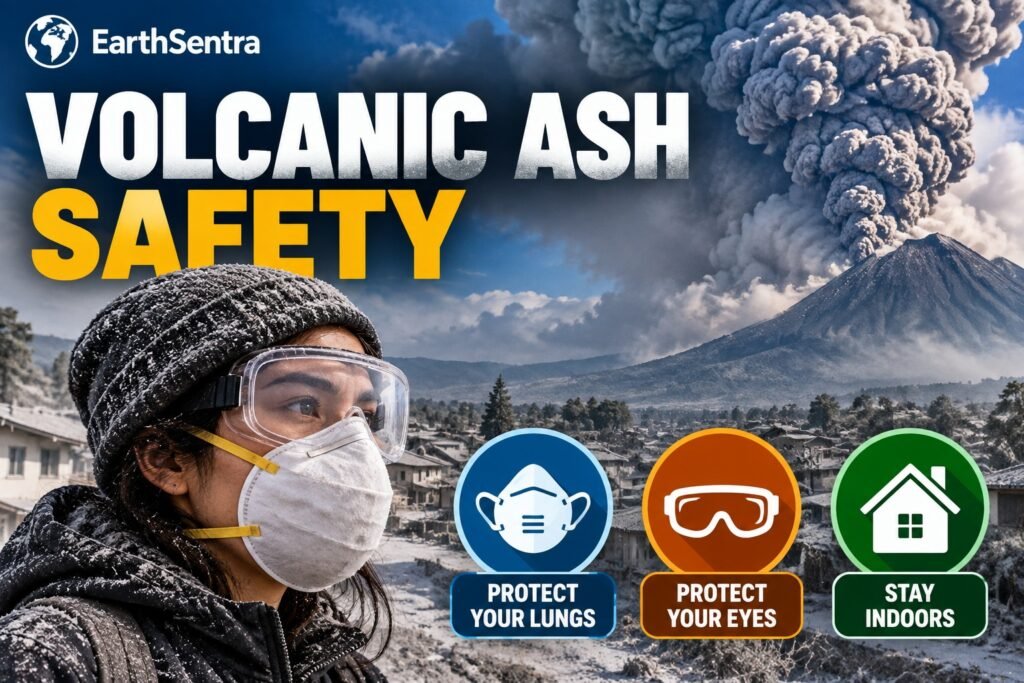
A properly fitted respirator designed to filter particles, such as an N95, can reduce inhalation of volcanic ash when going outside is unavoidable.
USGS recommends N95 respirators to reduce exposure to ash particles, particularly during cleanup operations.
Keep suitable respiratory protection available before an emergency occurs.
Protect Your Eyes
Include protective goggles in your emergency supplies.
If you normally wear contact lenses, keep regular glasses available as an alternative.
Prepare Your Home
Before ash arrives, when it is safe to do so:
- close doors and windows;
- identify openings through which outside air could enter;
- protect sensitive electronics and equipment;
- cover exposed water supplies;
- understand how your home’s ventilation system works.
The objective is to reduce the amount of volcanic ash entering the building.
Prepare Your Vehicle
If ashfall is possible, parking your vehicle under cover may reduce exposure.
Ash can affect air filters, moving components, and vehicle surfaces.
However, during significant ashfall, the safest approach is generally to avoid unnecessary driving.
During Volcanic Ashfall
Once ash begins falling, minimizing exposure becomes the priority.
Stay Indoors When Possible
Closing doors and windows helps reduce the amount of ash entering a building.
Limit outside air entering the home when significant ash is present and follow local guidance regarding ventilation or air-conditioning systems.
Reduce Outdoor Physical Activity
Strenuous physical activity increases the amount of air you breathe.
When the air contains volcanic ash, this can increase the amount of particles inhaled.
Avoid unnecessary outdoor exercise and physical activity during significant ash conditions.
Protect Yourself If You Must Go Outside
When going outside is unavoidable:
- wear appropriate respiratory protection;
- protect your eyes;
- limit the amount of time spent outside;
- follow specific instructions from local authorities.
Respirators must fit correctly to provide the level of protection for which they were designed.
Keep Children Indoors
Children can easily become exposed while playing in ash-covered areas.
Even after ash has stopped falling, walking, running, or playing on deposited material can resuspend particles into the air.
Avoid Driving
If travel is not essential, leave your vehicle parked.
In addition to mechanical risks, vehicles can resuspend ash and further reduce visibility.
Follow Official Updates
Wind direction can change.
An area that initially receives little or no ash may become affected later.
Follow official bulletins and pay attention to evacuation instructions, exclusion zones, or other safety measures.
After Volcanic Ashfall
When ash stops falling, the problem is not necessarily over.
Deposited ash can become airborne again for days or longer because of wind, vehicles, and cleanup activities.
Protect Yourself During Cleanup
Cleanup can generate large concentrations of airborne particles.
Use appropriate respiratory and eye protection.
Avoid cleaning methods that unnecessarily create large clouds of dust.
Local authorities may provide specific instructions depending on the type and amount of ash deposited.
Be Careful With Ash on Roofs
Do not climb onto an ash-covered roof without considering the risks.
Besides the danger of falling, significant ash accumulation may have added substantial weight to the structure.
When large accumulations occur, follow guidance from emergency authorities or qualified professionals.
Keep Ash Outside Your Home
Ash can be carried indoors on shoes, clothing, equipment, and pets.
Reducing the amount brought inside can help maintain cleaner indoor conditions.
Inspect Filters and Equipment
Ventilation systems, vehicles, machinery, and other equipment exposed to ash may require inspection or maintenance.
Do not assume equipment is clean simply because ash is no longer falling.
Volcanic Ash and Respirators
Not all face coverings provide the same level of particle filtration.
A properly fitted respirator designed to filter airborne particles provides greater protection against fine ash than ordinary cloth.
However, respiratory protection does not make every volcanic situation safe.
If authorities order an evacuation, wearing a respirator does not replace evacuation.
Official safety instructions always take priority.
Volcanic Ash and Rain
Rain may help remove particles from the air, but it can also create additional problems.
Wet volcanic ash becomes heavier on roofs and other surfaces.
Large amounts of volcanic material mixed with water can also contribute to other hazards, including volcanic mudflows or lahars, depending on the volcano and surrounding terrain.
An eruption therefore cannot be evaluated simply by observing whether ash is still falling.
Distance From a Volcano Does Not Eliminate the Risk
A common misconception is that only communities close to a volcano need to worry about ash.
Fine volcanic particles can travel great distances.
Wind speed and direction, eruption-column height, and particle size strongly influence where ash eventually falls.
This explains why ash advisories can affect regions located far from the erupting crater.
Volcano Alert Level and Ashfall Are Not the Same Thing
A volcano’s alert level describes its condition according to the system used by the responsible monitoring authority.
Whether a particular community receives ash also depends on the eruption characteristics and atmospheric conditions.
Therefore:
volcano alert level ≠ amount of ash at your location
A distant community may receive wind-blown ash while another area much closer to the volcano experiences little or no ashfall.
EarthSentra presents official volcano alerts separately from concepts such as observed activity and confirmed eruptions.
You can check current volcanic activity worldwide for the latest information available through EarthSentra.
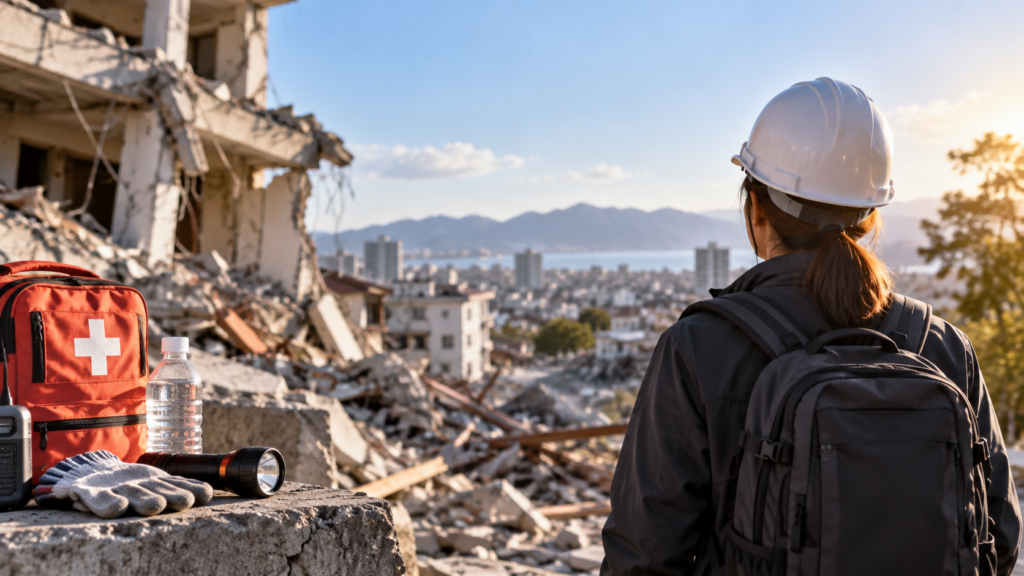
What to Include in a Volcanic Ash Emergency Kit
People living in volcanic regions may benefit from adding several ash-specific items to their basic emergency supplies:
- particle respirators;
- protective goggles;
- drinking water;
- regular medications;
- a radio or alternative way to receive emergency information;
- flashlight;
- protection for sensitive electronic devices;
- essential supplies for temporarily remaining indoors.
Exact requirements will depend on the location, household, and recommendations from local authorities.
People Who May Need Extra Precautions
People with asthma, bronchitis, emphysema, or other respiratory conditions may be more sensitive to volcanic ash exposure.
Children, older adults, and people with certain cardiovascular or respiratory conditions may also require additional precautions.
People who rely on regular medication should try to maintain an adequate supply and follow advice from their healthcare professionals.
Official Information Before Social Media Rumors
During volcanic eruptions, old photographs, maps without context, and alarming claims can spread rapidly online.
Before acting on such information, check:
who published it, when it was published, and which geographic area it refers to.
EarthSentra can help you follow volcanic activity around the world, but evacuation orders and public-safety instructions always come from the responsible authorities.
Frequently Asked Questions
Is volcanic ash the same as ash from a fire?
No. Volcanic ash consists mainly of fragments of rock, minerals, and volcanic glass. The particles can be hard and abrasive.
Can volcanic ash affect the lungs?
Yes. Fine particles can be inhaled deeply into the respiratory system. People with pre-existing respiratory conditions may be particularly vulnerable.
Should I drive during volcanic ashfall?
Avoid driving when it is not necessary. Ash can reduce visibility, make roads slippery, and damage vehicle filters and mechanical components.
Does an N95 respirator protect against volcanic ash?
A properly fitted N95 respirator can reduce exposure to airborne ash particles. It does not replace evacuation orders or other instructions from emergency authorities.
Is it safe to go outside after ash stops falling?
Not necessarily. Deposited ash can become airborne again because of wind, traffic, or cleanup operations, so exposure can continue after the initial ashfall.
Can volcanic ash damage a house?
Yes. Significant accumulation can place additional weight on roofs and affect ventilation systems, electrical equipment, machinery, and other infrastructure.
Sources
U.S. Geological Survey (USGS) / Volcano Hazards Program — volcanic ash hazards, health effects, preparedness, and ashfall safety guidance.
International Volcanic Health Hazard Network (IVHHN) — public-health guidance concerning volcanic ash exposure and protection.
World Health Organization (WHO) — health and infrastructure hazards associated with volcanic eruptions.