
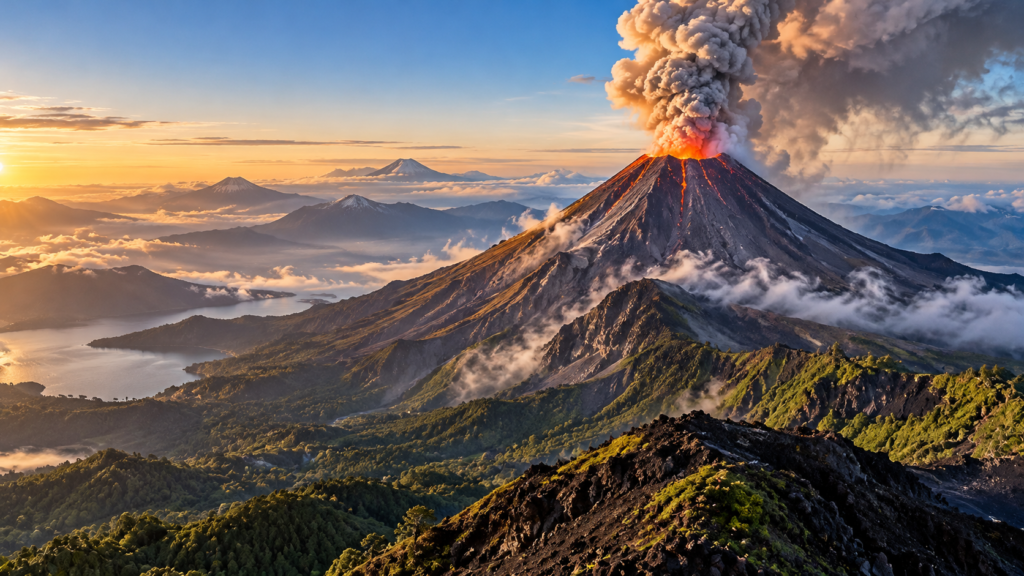
How many active volcanoes are there in the world? The answer depends on the definition of active. The Smithsonian Global Volcanism Program lists 1,214 Holocene volcanoes, while the U.S. Geological Survey estimates around 1,350 potentially active volcanoes, excluding many submarine systems. Neither figure means that all those volcanoes are erupting today.
This is an evergreen guide to volcanic activity and global distribution. For current monitoring and official warnings, visit EarthSentra’s volcanoes today hub.
What is an active volcano?
An active or potentially active volcano has erupted in geologically recent times or retains evidence that it could erupt again. The Holocene, spanning approximately the past 12,000 years, is commonly used in global catalogs. Definitions vary between scientific organizations.
Distinguish an active volcano from a currently erupting volcano and from a volcano under an official alert. Unrest does not always lead to eruption.
How many active volcanoes are there?
The Smithsonian database lists 1,214 Holocene volcanoes. The USGS estimates roughly 1,350 potentially active volcanoes worldwide, not counting much of the volcanism along deep-ocean spreading ridges. About 40–50 volcanoes are typically in continuing eruption at a given time according to GVP, but that fluctuates and is not a real-time count for this publication date.
Where are active volcanoes found?
Many lie near tectonic plate boundaries, particularly the Pacific Ring of Fire, but volcanoes also occur on mid-ocean ridges, continental rifts and hotspots such as Hawaii.
Examples of active volcanoes by region
| Region | Examples | Geologic setting |
|---|---|---|
| North and Central America | Popocatépetl (Mexico), Fuego (Guatemala), Kīlauea (Hawaii) | Subduction and hotspot activity |
| South America | Sabancaya (Peru), Reventador (Ecuador), Nevado del Ruiz (Colombia) | Nazca Plate subduction |
| Asia | Sakurajima (Japan), Merapi and Semeru (Indonesia), Mayon (Philippines) | Volcanic island arcs |
| Europe | Etna and Stromboli (Italy), Icelandic volcanic systems | Mediterranean tectonics and Atlantic ridge |
| Africa | Nyiragongo and Nyamulagira (DR Congo), Erta Ale (Ethiopia) | East African Rift and Afar |
| Oceania and Pacific | Yasur (Vanuatu), Ruapehu (New Zealand), Tonga volcanic systems | Subduction and island arcs |
These are examples of active or potentially active volcanoes, not claims that each is erupting in October 2026. See the Smithsonian country list for consistent catalog data.
Why are there so many volcanoes around the Pacific?
Where one tectonic plate descends beneath another, released fluids support melting in the mantle above and magma can rise toward the surface. This process creates volcanic arcs in the Andes, Central America, Japan, the Philippines and Indonesia. Other volcanoes, such as those in Hawaii or Iceland, form in different tectonic settings.
How do scientists monitor volcanoes?
Observatories combine seismic monitoring, ground deformation, volcanic gas measurements, thermal imaging, satellites and field observations. No single observation guarantees an eruption. Official volcano alerts reflect assessments and uncertainty.
Are all active volcanoes dangerous?
Hazards depend on the volcano, activity style, topography and exposure. Volcanic ash, lava, gases, pyroclastic flows and lahars can threaten communities. Explore types of volcanoes, pyroclastic flows and volcano alert levels.
Where can I find current eruptions and alerts?
Use the Smithsonian GVP for a research database and eruption reports; for immediate hazards consult local observatories. EarthSentra’s volcanoes today hub distinguishes catalog records, eruptions and official alert levels.
Frequently asked questions
How many active volcanoes are there worldwide?
The Smithsonian lists 1,214 Holocene volcanoes, and the USGS estimates roughly 1,350 potentially active volcanoes. Neither count represents simultaneous eruptions.
Which country has the most active volcanoes?
It depends on whether you count Holocene volcanoes, historical eruptions or currently erupting systems. Indonesia, Japan and the United States contain many; comparisons require a consistent definition.
Can a volcano erupt again after centuries of quiet?
Yes. Dormant periods may last centuries or longer. A quiet volcano is not necessarily extinct.
Does active mean erupting now?
No. Active generally refers to geological history or eruptive potential rather than a live eruption.
Scientific sources
- Smithsonian GVP: Active volcano counts
- Smithsonian GVP: Holocene Volcano List
- USGS: Active volcanoes on Earth
- Smithsonian GVP: Volcanoes by country
Reviewed October 2026. This is not a live alert page.

