Understanding earthquake magnitude vs. intensity helps you distinguish the size of a quake from the shaking and effects felt at a particular location.
Earthquake magnitude describes the size of an earthquake at its source. Seismic intensity describes the shaking and its effects at a particular location. One earthquake can therefore feel different in two cities: the event is the same, but the shaking reaching each place is different.
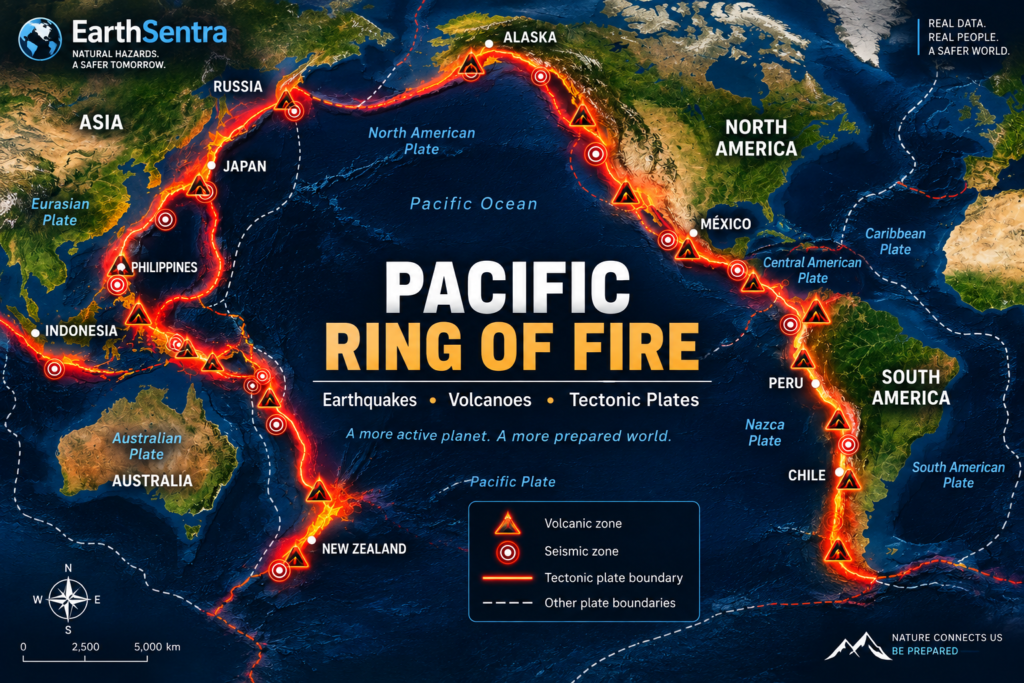
When reading a report, distinguish the magnitude number from the intensity values reported for individual locations. These measurements also differ from the position of the epicenter and hypocenter.
Earthquake magnitude vs. intensity: the essential difference
Magnitude answers “How large was the earthquake?” Intensity answers “How did it affect this location?” The first characterizes the event; the second requires a place and a named scale. A report saying only “intensity 6” is incomplete unless it identifies where the value was observed and which scale was used.
Richter and moment magnitude: what ML and Mw mean
Local magnitude, ML, comes from the method developed by Richter and Gutenberg in 1935. It uses recorded seismogram amplitude with distance corrections. It still has applications for small local earthquakes; describing every magnitude as “Richter” can be inaccurate.
Moment magnitude, Mw, is calculated from seismic moment, which relates to rock rigidity, the fault area that ruptured and the amount of slip. It is widely used to characterize large earthquakes. Catalogs may also report types such as mb or Md. Keep the source’s magnitude label when it is available.
Is a magnitude 6 earthquake twice as large as magnitude 3?
No. Magnitude is logarithmic. For a rough energy comparison, an increase of one magnitude unit corresponds to about 32 times more energy; two units correspond to about 1,000 times. A magnitude 6 earthquake therefore releases roughly 32 times the energy of a magnitude 5 event. This approximate relationship does not mean 32 times more damage or 32 times stronger shaking in your home.
Modified Mercalli and Shindo: intensity scales
The Modified Mercalli Intensity scale describes local effects using Roman numerals from I to XII. It considers observations involving people, objects, buildings and the surrounding environment. A magnitude value and a Mercalli intensity are different measurements.
In Japan, JMA uses the Shindo intensity scale, with ten categories: 0, 1, 2, 3, 4, 5 Lower, 5 Upper, 6 Lower, 6 Upper and 7. Values are normally measured using instruments. “Shindo 5 Upper” does not mean magnitude 5 and is not automatically equivalent to Mercalli V.
Why the same earthquake feels different in different places
Distance from the rupture, depth, ground conditions and wave propagation influence shaking. Buildings also respond differently: experiences can vary within a city and between floors of the same building.
In a hypothetical example, a report could describe a magnitude 6 event with different intensities in several communities. There is no contradiction. Before comparing reports, check whether they describe the size of the event or local effects. Neither magnitude nor an isolated intensity value establishes whether a building is safe.
How to read an earthquake report
Check the date, time, source and latest update. Identify magnitude and its type, the epicenter and depth. If intensity is reported, look for the location and scale name. Our earthquakes today page lists recent records; consult the relevant official agency for local shaking information.
Why preliminary magnitudes can change
Initial values may be revised as additional records, analysis and human review become available. A revised magnitude does not mean the earthquake grew after it happened. Compare sources and update times before interpreting different values.
Frequently asked questions
Does magnitude tell us how much damage will occur? It cannot do so alone. Exposure, construction and local conditions also matter.
Can Mw be converted directly to Shindo or Mercalli? There is no single conversion valid for every location.
What should I check after feeling an earthquake? Identify the event, then look for intensity information for your location. For practical guidance, see what to do during an earthquake and what to do afterward.
Sources
USGS: Magnitude, Energy Release and Shaking Intensity; Magnitude Types; Modified Mercalli Intensity Scale; Magnitude updates. JMA: Seismic Intensity Scale.