
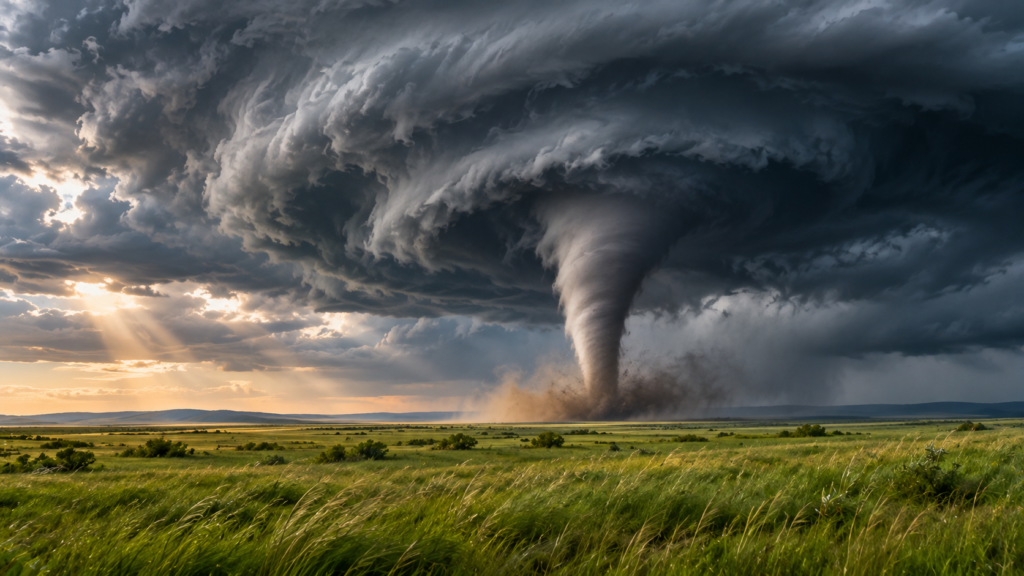
A tornado is a violently rotating column of air extending from a thunderstorm to the ground. It may appear as a funnel-shaped cloud, but a tornado can touch the surface without a fully visible condensation funnel. Its winds and airborne debris can cause severe damage in a narrow path.
How do tornadoes form?
Many of the strongest tornadoes develop within supercells—severe thunderstorms with a sustained, rotating updraft called a mesocyclone. Wind shear, or changes in wind speed and direction with altitude, helps organize the rotation. Interactions between rising and descending air near the ground may then intensify the rotation. Scientists are still studying exactly why one storm produces a tornado while another does not: most supercells do not produce tornadoes.
Different types of tornadoes
Supercell tornadoes are often among the most destructive. Other tornadoes form within lines of thunderstorms or through processes that do not require an established supercell. Landspouts may develop when rotation near the surface is stretched as a thunderstorm grows. Waterspouts occur over water, and some may be linked to severe thunderstorms. Ordinary dust devils are different and should not automatically be labeled tornadoes.
How strong is a tornado? Understanding the Enhanced Fujita Scale
In the United States, the Enhanced Fujita (EF) Scale classifies tornadoes from EF0 to EF5 using damage assessments of buildings, trees and other structures. Wind speeds are generally estimated from the damage indicators, not directly measured in every tornado.
| Rating | Estimated winds | Typical description |
|---|---|---|
| EF0 | 65–85 mph | Light damage |
| EF1 | 86–110 mph | Moderate damage |
| EF2 | 111–135 mph | Considerable damage |
| EF3 | 136–165 mph | Severe damage |
| EF4 | 166–200 mph | Devastating damage |
| EF5 | Over 200 mph | Extreme damage |
Tornado Watch vs. Tornado Warning
In the U.S., a Tornado Watch means atmospheric conditions are favorable for tornadoes in the watch area: stay alert and review your shelter plan. A Tornado Warning means a tornado has been detected or indicated by radar in an area and you should take shelter immediately. Always follow the current instructions from the National Weather Service and local emergency officials.
Where do tornadoes happen in the United States?
Although tornadoes can occur in many states and at different times of year, some regions have higher seasonal concentrations. The central Great Plains are commonly associated with Tornado Alley, and portions of the Southeast also experience dangerous tornado outbreaks, including nighttime events. There is no single fixed border or entirely safe season.
Tornado vs. hurricane: key differences
A tornado is a localized rotating column associated with a thunderstorm. A hurricane is a much larger tropical cyclone fueled by warm ocean conditions. Hurricane rainbands can also spawn tornadoes, but the two phenomena differ in size, duration and formation. See EarthSentra’s guide to how hurricanes form for the broader atmospheric processes.
What should you do during a tornado?
Go to a basement, storm shelter or small windowless interior room on the lowest floor of a sturdy building. Protect your head and neck and stay away from windows. Mobile homes and vehicles offer poor protection; move to a sturdy shelter before the storm arrives whenever possible. Do not shelter beneath highway overpasses. If caught outside without suitable shelter, follow emergency guidance based on the immediate situation; there is no universally safe last-resort option.
Frequently asked questions
Can a tornado exist without a visible funnel?
Yes. The visible condensation funnel may not reach the ground even when the rotating air does.
Do all supercells produce tornadoes?
No. Only a minority of supercell thunderstorms produce tornadoes, and the reasons remain an active field of research.
Can forecasters predict exactly where a tornado will start?
They can identify environments conducive to tornadoes and issue warnings for detected threats, but exact time, location and intensity remain uncertain.
Does opening windows help during a tornado?
No. Do not waste time opening windows; immediately move to a safe interior shelter.
Read our guide to types of natural disasters for related hazards.
Official scientific references
- NOAA NSSL: Tornado Basics
- NOAA NSSL: Types of Tornadoes
- NOAA: Tornado Formation and the EF Scale
- National Weather Service: Tornado Safety Rules
Educational guide published November 2026. Featured image is conceptual artwork, not an actual photograph of a specific tornado.

